The Península de
Nicoya Is Sinking,
Experts Say
A study by the
Observatorio
Vulcanológico y
Sismológico Nacional (OVISICORI)
that began in 1991 shows
that the Coco tectonic
plate is sinking the
Península de Nicoya on
the Pacific coast. The
study indicates that the
Península is sinking at
about 25 millimetres a
year and it is unknown
when the sinking began.
The numbers were
confirmed by geologists
Marino Protti and Victor
Cordero.
The influence of
phenomenon is easy to
identify in certain
coastal regions,
especially near the
beaches.
Many Guanacastecos
(residents of the
province of Guanacaste)
believe that the sea is
reclaiming it belongs to
it.
However the reality is
different. The Coco
plate collides with the
Península de Nicoya,
which does not have the
capacity to detain the
plate and gives under
the pressure, which
causes the sinking.
Protti and Cordero
believe that a 40 second
earthquake of 7.7 on the
Richter scale could sink
the entire Península.
The phenomenon is
not new.
The geologists are using
high technology to make
their calculations,
using 12 Global
Positioning System (GPS)
units costing about
us$20.000 each.
The GPS units are spread
out in different areas
of the Península and
register its exact
position thanks to
information provided by
the satellites overhead.
Using the GPS units the
geologists have been
able to confirm the 25
millimetres sinking per
year.
Protti added that the
sinking is not uniform
in all areas of the
Península, in some areas
it is less.
The work being carried
out by Protti and
Cordero has the support
of the University of
California, Santa Cruz
and the University of
Miami.
The two universities are
working together with
the Costa Rican Comisión
Nacional de Emergencias
(CNE), which has been
working in the
communities to prevent
an eventual disaster in
the Península de Nicoya.
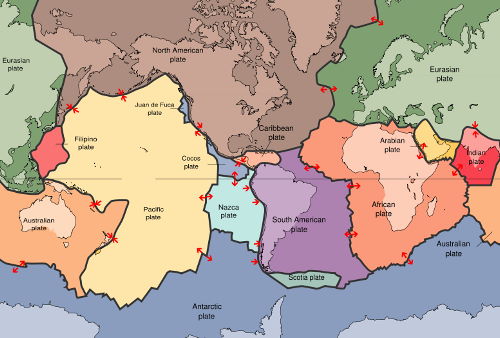
The tectonic plates of
the world were mapped in
the second half of the
20th century. |
|


