|
US House Passes Central American
Trade Pact
The United States House of
Representatives voted late
Wednesday to ratify the Central
American Free Trade Agreement,
handing President Bush a
hard-fought victory on a measure
with limited economic effects
but large political
consequences.
CAFTA, approved 217 to 215 after
about three hours of contentious
debate and a roll call that
lasted longer than an hour, will
remove most trade barriers
between the United States and
Costa Rica, El Salvador,
Guatemala, Honduras, Nicaragua
and the Dominican Republic.
The trade pact was approved by
the Senate last month, 54 to 45.
Most of its provisions take
effect immediately; the rest
will be phased in over 20 years.
The late-night House vote capped
weeks of high-pressure lobbying
and deal-making by Bush
administration officials,
Republican leaders in Congress
and outside business groups who
viewed CAFTA's approval as
essential to advancing U.S.
commercial interests, foreign
policy goals and GOP political
objectives.
"CAFTA is a little trade
agreement with small economic
consequences for our country,"
Rep. Jim Kolbe (R-Ariz.) said
shortly before the roll was
called. "But it is a huge
national security issue with
enormous implications for our
entire foreign policy."
The measure was fiercely opposed
by most congressional Democrats
and some Republicans who
considered its labor and
environmental provisions lacking
and who saw the pact as
emblematic of problems
associated with globalization,
including U.S. job losses and
China's economic gains.
"It is a step backward for
workers in Central America, and
a job-killer here at home," said
House Minority Leader Nancy
Pelosi (D-San Francisco). The
agreement "hurts U.S. workers …
and fails to protect the
environment," she said.
Rep. Bill Thomas
(R-Bakersfield), the Ways and
Means Committee chairman who
steered the bill through the
House, said the near-unanimous
opposition of Democrats would
help the Republican Party
solidify its political gains of
recent years.
"I wondered when this moment
would come. Apparently it comes
tonight," Thomas said before
declaring an end to debate.
"Tonight … we mature into a
permanent majority. We will
lead. We will be progressive. We
will help our neighbors."
Supporters acknowledged that
CAFTA's economic impact would be
relatively small. Total two-way
trade between the United States
and the six other CAFTA
countries is $32 billion a year,
a tiny slice of America's
$11-trillion economy.
But CAFTA's political symbolism
loomed large.
Congress has not rejected a
major trade pact in more than
four decades, and CAFTA's defeat
could have undermined Bush's
efforts to encourage the spread
of democracy to combat
terrorism, and to negotiate
bigger hemispheric and global
trade agreements.
CAFTA was also seen as an
important test of Bush's ability
to steer major legislation
through Congress in his second
term. The president's top
domestic priority, Social
Security restructuring, has
stalled in the face of
unexpectedly strong opposition
and lukewarm Republican support.
Bush applauded the House for
approving the pact.
"This agreement will level the
playing field and help American
workers, farmers and small
businesses," he said in a
statement. "The agreement is
more than a trade bill; it is a
commitment of freedom-loving
nations to advance peace and
prosperity throughout the
Western Hemisphere."
In the hours leading up to the
floor vote, political operatives
and congressional aides on both
sides of the issue said it
remained unclear whether the
White House had sewn up enough
votes to ensure CAFTA's passage.
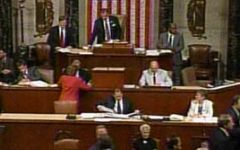
The GOP leadership held the vote
open for more than an hour, well
beyond its scheduled 15-minute
expiration. Onlookers gazed from
the galleries and members milled
about on the floor as leaders
rounded up the last few votes
they needed to put CAFTA over
the top.
In the end, 202 Republicans
voted for CAFTA and 27 against
it. Most of the GOP defectors
represented districts with small
manufacturers, textile makers or
sugar growers that feared they
would be hurt by CAFTA's
provisions.
On the other side of the aisle,
15 Democrats voted for the
agreement and 187 against, along
with one independent. The
opponents included a number of
pro-trade Democrats who had
backed previous agreements, a
reflection of the slippage that
has occurred since Bush took
office.
Two members — Republicans from
Virginia and North Carolina —
did not vote. The House has one
vacancy.
The California delegation split
along party lines, with all
Republicans supporting the pact
and all Democrats opposing it.
Many of the opponents cited the
disillusionment that followed
approval of the North American
Free Trade Agreement, the
landmark 1994 accord that
eliminated trade barriers with
Canada and Mexico and was blamed
for subsequent losses of factory
jobs, particularly in the
textile and apparel industries.
"CAFTA is NAFTA's ugly cousin,"
Rep. Walter B. Jones (R-N.C.)
said.
Rep. Howard Coble of North
Carolina, one of the GOP members
who bucked the president and
party leaders, said he had told
Bush about his late mother, who
sewed pockets in overalls in a
North Carolina apparel plant.
"When textile workers,
especially female workers, plead
with me to vote against CAFTA, I
said to the president, 'It's my
mama talking to me,' " Coble
said. "I cannot turn a deaf ear
to those pleas."
Bush and his allies used two
basic arguments to try to
overcome such concerns. One
emphasized America's economic
interests, the other its
national security.
Although the CAFTA economies are
small, they collectively
represent America's 10th-largest
export market, and the second
largest in Latin America, behind
Mexico. About 80% of the
region's exports already enter
the United States duty-free
under the existing Caribbean
Basin Initiative. A much higher
percentage of U.S. exports are
subject to tariffs that would be
removed under CAFTA, including
many agricultural products grown
in California and other farm
states.
Rep. Wally Herger
(R-Chico) said the rice,
almonds, pistachios and dried
plums that come from his
Northern California district now
face average tariffs of 35% to
60% in the CAFTA countries.
"This is vitally important to
all U.S. agriculture, especially
in my home state," he said.
In recent days, Bush and his
allies have placed increasing
emphasis on the national
security argument. They said
CAFTA's approval was necessary
to demonstrate U.S. support for
the fledgling democracies of
Central America, whose citizens
only recently emerged from years
of authoritarian rule and whose
future prospects will be
determined in part by economic
advances.
"For 500 years, they've been
suffering. They need and
certainly deserve a seat at the
table of the global economy,"
said Rep. James P. Moran (D-Va.),
one of the few members of his
party who voted for CAFTA. "It
is important to be on the right
side of the political equation,
but it's even more important to
be on the right side of
history."
As the showdown neared, the
sales effort became more
intense. It included a personal
appeal by Bush and Vice
President Dick Cheney, who were
whisked to the Capitol by
motorcade Wednesday morning to
ask House Republicans to support
the president's legislative
priorities. Participants said
Bush spent about 30 minutes
talking about CAFTA.
Rep. Bob Ney (R-Ohio) said the
lobbying didn't stop even after
he announced early Wednesday
that he would vote against the
agreement. By late afternoon, he
was still hearing from
high-ranking administration
officials, including Commerce
Secretary Carlos M. Gutierrez.
"I'm getting calls as we speak,"
Ney told a reporter in a Capitol
hallway.
Ney said CAFTA was opposed by
many people in his district who
saw it as part of a broader
globalization process that had
contributed to America's big
trade deficit with China,
repeated rounds of factory
closings and the "outsourcing"
of U.S. jobs to other countries.
"People relate trade agreements
with loss of jobs, and they want
something done," Ney said. "I
know that CAFTA is not China,
but my constituents don't."
The sales campaign employed a
combination of political carrots
and sticks. Administration
officials and Republican leaders
made it known that they were
willing to negotiate side
agreements and consider special
requests to win votes. One
last-minute deal provided
special protections for
manufacturers of denim cloth and
trouser pockets, and brought at
least five Southern Republicans
on board.
At the same time, Bush's aides
and allies pressured Republican
holdouts to support the
president or face possible
political repercussions. The
U.S. Chamber of Commerce spread
the word that it would reduce
financial support for lawmakers
who voted against CAFTA.
Earlier Wednesday, the House
voted to improve oversight of
China's trade practices,
approving a relatively modest
measure that might not have seen
the light of day if not for
CAFTA.
The China bill, adopted 255 to
168, authorizes U.S. officials
to impose retaliatory tariffs
when the governments of "nonmarket"
economies such as China are
found to be subsidizing their
export industries. The bill also
calls for increased monitoring
of China's currency policies and
trade law compliance.
Sponsors called it a measured
response to widespread concern
about China's willingness to
abide by the rules of global
trade. Opponents described it as
a ploy by Republicans to improve
CAFTA's prospects.
The China bill was not embraced
by the White House, but House
leaders agreed to bring it to a
vote in a deal that persuaded a
handful of Republicans to
support the Central American
trade agreement.
|
|