|
Scooter
Sales On the Increase
By scooter is the only way to
go. It is practical, fast and
economical. And it has become a
trend.
With the increasing price of
gasoline, more and more Costa
Ricans are turning to the two
wheeled method of
transportation, as reflected by
sales, which has increased over
30% in the last couple of years.
In 2006 alone, retailers are
expected to sell 12.000 brand
new scooters.
Scooters save time and money.
Stuck in growing traffic jams of
San José is no fun on the nerves
or the pocket book.
A scooter can run an average of
200 kilometres on a single 3.7
litre tank of gasoline, which,
at current prices, costs ¢1.750
colones (us$3.50). In practical
terms, that is 54 kilometres per
litre, or 20 times back and
forth between La Sabana and
downtown San José.
On the market there are all
kinds of models and sizes and
colours, from a small 50cc
scooter that is suitable for one
person, to the more powerful
250cc. For enthusiasts there are
couple of 600cc - big scooters -
to choose from.
However, the favourites are the
100cc and 125cc models,
economical, yet powerful enough
to make it up and down the hills
around town and up the Escazú
mountain.
Scooter dealers have sprung up
all over town. Along the Uruca
there are a number of scooter
dealers offering Japanese models
like the Yamaha, the Genesis
from China and the Italian Vespa.
Prices range from as low as
¢450.000 colones (us$995.) to
¢1.2 million colones (us$2.500),
depending on the model,
manufacturer and engine size.
Financing packages allow
customers to easily own their
own transportation.
A word of caution on buying a
scooter - the Chinese models are
cheaper that their Japanese or
European counterparts, however,
don't count with service support
and parts availability. Buying a
scooter from a reputable dealer
can make all the difference
between riding and walking.
In Costa Rica, a helmet is
mandatory for riding a scooter.
50cc and 75cc scooters -
classified as "bicimoto" (moped)
do not require a motorcycle
license.
History of the Scooter
The Vespa originally
manufactured by Piaggio in post
World War II Italy with aircraft
materials and styling became the
first of the road motor scooters
and defined the vehicle type for
three and a half decades.
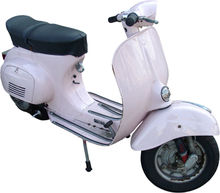
A
Vespa
In the 1980s new versions of
scooters began to be released
and become popular, especially
in Japan and Far-East Asia.
This styling of scooters began
to reflect that of larger,
sporty, higher-performance
motorcycles of the time and the
trend has continued to the
current day. With the release of
the Honda Ruckus, there may be a
new trend towards dirt-bike
scooters just beginning.
The classic styling of the Vespa
has never lost its popularity,
however and remains the most
popular and most imitated
scooter design. Almost all
manufacturers now carry both a
classic/retro model and a
sporty/modern model.
Scooter brands sold in Costa
Rica:
Adly (Taiwan)
Aprilia (Italy)
Bajaj (India)
Honda (Japan)
Kymco (Taiwan)
LML (India)
Peugeot (France)
Piaggio (Italy)
Suzuki (Japan)
Vespa, brand by Piaggio (Italy)
Yamaha (Japan)
* There are a number of Chinese
products that are sold under
various names and not listed
above. Insist on knowing the
country of manufacture, as it
will greatly determine price,
resale value, service and parts
support.
|
|
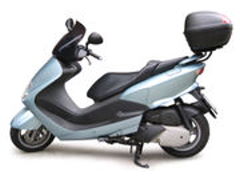
A motor scooter is a motorcycle with a step-through frame in which
the rider sits without straddling any part of the engine. Most
modern motor scooters have wheels smaller in diameter, between 8 and
14 inches (20-35 cm), than other motorcycles.
The engine is usually found under the seat with a continuously
variable transmission transferring power to the rear wheel.
See history of the scooter
See scooter brands
sold in Costa Rica
|
|
|
|
|
|
|


