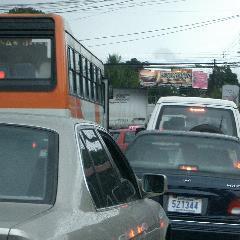
San José Has Bad Air,
Study Reveals
Just walking a block in
downtown San José is all
that is necessary to
know what has been
confirmed by science,
the air San José stinks
and is contaminated. The
smoke, stench and
burning eye sensation is
evident all day long,
but worse during morning
and afternoon rush
hours.
An analysis of air
quality done by the
Universidad Nacional (UNA)
in 2007 reveals that 75%
of all vehicles in the
country and 70% of all
industry in located in
the Gran Área
Metropolitana (GAM) -
greater metropolitan
area.
The study shows that
nitrogen dioxide levels,
manganese and particular
matter in five distinct
points of downtown San
José are well above
international standards
set by the World Health
Organization (WHO).
Particulate matte can be
solid or liquid and
includes dust, soot,
ash, cement and pollen.
The smaller the matte
is, the more dangerous
as it can more easily
penetrate a person's
lungs and cause
respiratory problems and
aggravate asthma.
The UNA used 14
monitoring stations set
up in the GMA collectin
data during 2007.
The analysis revealed
that heavy metal
manganese and nitrogen
dioxide levels were
found to be consistently
unsafe all year round in
the downtown area as was
all the Sabana Sur
neighbourhood.
Particulate matter was
above safe levels in
March, April, July,
September and November.
The UNA study shows that
vehicles are the primary
source of the air
contamination.
"The country has old
cars and in general
bring with them
problems", said Olman
Segura of the UNA.
Environment minister,
Jorge Rodríguez,
expressed concern of the
high levels.
Since 1990 the number of
vehicles in the country
has been growing at an
average rate of 8.45%.
Municipalidad of San
José mayor, Johnny
Araya, says that to
reduce contamination in
the capital there must
be a reduction of the
number of vehicles
coming into the downtown
core.
Currently, 20% of all
vehicles are restricted
entry into downtown
between Monday and
Friday in the mornings
between 7:00am and
8:30am and in the
afternoons between
4:00pm and 5:30pm,
determined by the
vehicles last digit of
the license plate: 1 & 2
on Mondays, 3 & 4 on
Tuesdays, 5 & 6 on
Wednesdays, 7 & 8 on
Thursdays and 9 & 0 on
Fridays.
Araya added that the
municipality is
evaluating the use of a
train or streetcar in an
effort to improve public
transportation in the
downtown area.
At the end of this
month, the intersectoral
buses will begin
operating, connection
communities without
having to transfer in
downtown San José.
Seguras says that unsafe
levels are a result of
the government's failure
to deal with the
problem.
The areas with the
highest levels of
contamination are: San
Juan de Dios, Catedral
Metropolitana, Paseo de
los Estudiantes, Barrio
Cuba and Avenida 10. |