|
|
 Decree Requires
Yellow Fever Vaccination From Visitors
of High Risk Countries Like Colombia
Decree Requires
Yellow Fever Vaccination From Visitors
of High Risk Countries Like Colombia
300.000 GSM Lines
Purchase Approved
More than 150
International Observers
To Be Present For
Referendum
Effective Social
Policies Urgently Needed
in Latin America, Arias
Says
Family Waiting on
Return of Body To Nicaragua |
|
Decree Requires Yellow
Fever Vaccination From
Visitors of High Risk
Countries Like Colombia
and Venezuela
In the coming months,
visitors to Costa Rica
from countries with a
high risk of "yellow
fever" will require a
certificate known as "Certificado
Internacional de
Vacunación contra la
Fiebre Amarilla" before
they will be allowed to
enter.
To that end, the
government issued a
decree, which has been
published in the
official government
publication, La Gaceta,
that put the control in
place within three
months of publication,
that is to say,
November.
The decree resulted from
a government concern
over yellow fever in
Africa, South America
and the Caribbean.
The countries on the
control list include:
Angola, Benin, Burkina
Faso, Cameroon, Bolivia,
Venezuela, Perú,
Colombia, Ecuador and
French Guyana.
The Costa Rican
government is asking
that visitors from those
countries provide proof
of vaccination to ensure
the security of public
health in Costa Rica.
The measures were
adopted due to a Dengue
epidemic in the country,
mostly affecting the
province of Limón on the
Caribbean coast, that is
carried by the Aedes
aegypti mosquito, that
is also a carrier of the
yellow fever.
The government felt the
need to consider the
measure due to the high
influx of visitors from
high risk countries.
The duty to comply with
the order falls on the
ministerios de Salud,
Gobernación y Policía,
Seguridad Pública y al
de Relaciones Exteriores
y Culto.
"We declare the
obligatory vaccination
against yellow fever
before being permitted
to enter thec ountry of
persons coming from
geographical areas
considered high risk,
for which they will be
required to provide
proof by way of a
‘Certificado
Internacional de
Vacunación contra la
Fiebre Amarilla’, which
is valid after 10 days
of vaccination and
authorized by the land
border controls and the
airports and ports" are
wording included in
article 3 of the
government decree.
Article 8 is more
specific in that it
gives the immigration
authorities the right to
refuse any person from
the high risk countries
entry into Costa Rica
without a valid and
current Certificado
Internacional de
Vacunación contra la
Fiebre Amarilla.
At the same time,
individuals from the
high risk countries who
leave Costa Rica must
get vaccinated if they
intend to return. In
that case, they can
obtain a certificate
from the ministerio de
Salud in Costa Rica
before leaving.
Yellow fever (also
called yellow jack,
black vomit or vomito
negro, or sometimes
American Plague) is an
acute viral disease. It
is an important cause of
hemorrhagic illness in
many African and South
American countries
despite existence of an
effective vaccine. The
yellow refers to the
jaundice symptoms that
affect some patients.
Symptoms
The virus remains
silent in the body
during an incubation
period of three to six
days. There are then two
disease phases. While
some infections have no
symptoms whatsoever, the
first, acute phase is
normally characterized
by fever, muscle pain
(with prominent
backache), headache,
shivers, loss of
appetite, and nausea
and/or vomiting. Often,
the high fever is
paradoxically associated
with a slow pulse (known
as Faget's sign). After
three to four days most
patients improve and
their symptoms
disappear.
However, 15 percent of
patients enter a toxic
phase within 24 hours.
Fever reappears and
several body systems are
affected. The patient
rapidly develops
jaundice and complains
of abdominal pain with
vomiting. Bleeding can
occur from the mouth,
nose, eyes and/or
stomach. Once this
happens, blood appears
in the vomit and feces.
Kidney function
deteriorates; this can
range from abnormal
protein levels in the
urine (proteinuria) to
complete kidney failure
with no urine production
(anuria). Half of the
patients in the "toxic
phase" die within ten to
fourteen days. The
remainder recover
without significant
organ damage.
Yellow fever is
difficult to recognize,
especially during the
early stages. It can
easily be confused with
malaria, typhoid,
rickettsial diseases,
haemorrhagic viral
fevers (e.g. Lassa),
arboviral infections
(e.g. dengue),
leptospirosis, viral
hepatitis and poisoning
(e.g. carbon
tetrachloride). A
laboratory analysis is
required to confirm a
suspect case. Blood
tests (serology assays)
can detect yellow fever
antibodies that are
produced in response to
the infection. Several
other techniques are
used to identify the
virus itself in blood
specimens or liver
tissue collected after
death. These tests
require highly trained
laboratory staff using
specialized equipment
and materials.
Treatment
There is no true
cure for yellow fever,
therefore vaccination is
important. Treatment is
symptomatic and
supportive only. Fluid
replacement, fighting
hypotension and
transfusion of blood
derivates is generally
needed only in severe
cases. In cases that
result in acute renal
failure, dialysis may be
necessary. A fever
victim needs to get lots
of rest, fresh air, and
drink plenty of fluids.
|
|
|
|
|
|
|
|
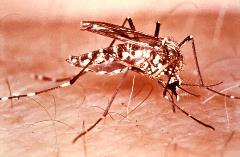
The female Aedes aegypti mosquito on a
human host, about to obtain a blood meal |
|
|
| |
|


