|
Two Minors Ask Court For Right
Not To See Their Grandparents
In an unprecedented case, the
Sala Constitucional
(Constitutional Court) is being
asked by two young girls, aged
seven and ten, for the right to
choose whom they wish not to
see, in this case, their
maternal grandparents, who head
the list.
Although the request is odd,
their father assures that is the
wish of his girls and is asking
the ConstitutionalCourt to
listen to them.
The reason for the unusual
request is personal and makes it
the first the time the
Constitutional Court has had a
request from a minor.
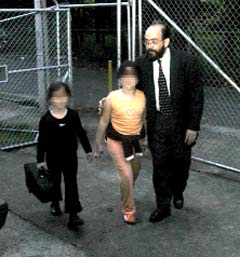
Gilberto Espinosa, the young
girls father, explained that the
situation is very uncomfortable
for the family that has been in
dispute over the situation for
the last three years, as the
maternal grandparents have
solicited the aid of various
government institutions to force
to see their granddaughters.
Espinosa assures that the family
dispute is not based on sexual
or physical violence against the
children and has reached the
halls of the Juzgado Segundo de
Familia de San José (San José
family court) who has ordered
the two young girls to sit with
their grandparents and
psychologist to assist in a
reconciliation.
The court decision forcing the
meeting is what has prompted the
Constitutional Court action.
The young girls are adamant that
they do not want the
reconciliation and do not want
to see their grandparents.
The parents are supporting their
children's efforts, saying that
the visit would be too traumatic
on them and that they have the
right not to attend the court
ordered reconciliation meeting,
similar to a situation where
parents are divorced.
"I will present a letter to the
Sala IV (Constitutional Court)
that they respect my right to
choose not to seem them and not
be obligated... I don't want to
see them because they make me
suffer a lot", said the ten year
old girl as she stood by her
father's side.
Espinosa said that in past
occasions when his girls had
occasion to meet with their
grandparents, the girls suffered
nightmares and were stressed out
for up to a week, worried and
frightened to have to see them
again. "I don't want my girls to
have to suffer that", said
Espinosa.
Espinosa added that the
Patronato Nacional de la
Infancia (PANI) - the child
welfare agency - denied the
grandparents the right to stay
with the girls. However, the
grandparents have been insisting
and have pleaded the help of
other government institutions,
including the family courts.
The "recurso amparo" - appeal -
is the first in the history of
the Constitutional Court and it
is hoped that this will put an
end to the three long family
dispute.
The Constitutional Court
magistrates will now have the
task of deciding if children
have the right or not to see
their grandparents or any any
other person they choose not to
see, a decision that they can
then evaluate again when they
become of age.
|
|