|
Nicaragua Wants Guanacaste
Back
The decision by Costa Rica to
send the dispute over right to
navigate the San Juan to the
International Court has now
Nicaragua's foreign minister,
Normal Caldera, saying that his
country will ask that Costa Rica
give back Guanacaste.
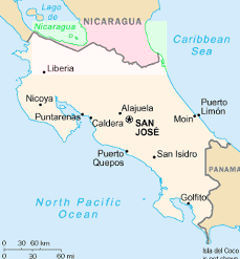
Nicaragua claims that Guanacaste
belongs to it and was seized by
Costa Rica back in 1825, when
the Partido de Nicoya made the
decision of annexation with
Costa Rica.
Caldera, on Nicaraguan
television, said that his
country is analyzing the
possibility of reclaiming
Guanacaste from Costa Rica.
"There are those who say, well,
if now Costa Rica doubt the
Laudo Cleveland, we have
doubt and ask that Guanacaste be
returned to us, in a
counterattack", said Caldera.
Caldera added that the demand is
coming from a number of
"jurists" from within the
Nicaraguan government.
Costa Rica obtained navigational
rights to the San Juan in the
Cañas-Jerez agreement of 1858
and confirmed by the Laudo
Cleveland agreement of March
1888, which forms part of the
Costa Rica's political
constitution, which states that
the border limits between Costa
Rica and Nicaragua is determined
by the Cañas-Jerez agreement of
15 April 1858, ratified by the
Laudo Cleveland of 22 March
1888.
Costa Rica is clear that the
river belongs to Nicaragua and
in its history has never made a
claim for it.
However, following the
annexation of the Partido de
Nicoya to Costa Rica in 1824,
Nicaragua made several claims
for the territory that is now
Guanacaste. To bring a solution
to the claims, several treaties
were made, the last being the
Cañas-Jerez and later confirmed
by U.S. President Grover
Cleveland (known as the laudo
Cleveland), who cleared up the
dubious points of interpretation
in the agreement over the
border.
Costa Rica's president, Abel
Pacheco, said that he won't even
bother to analyze Nicaragua's
claim, because, in his words "it
is out of place".
Roberto Tovar, Costa Rica's
foreign minister, added that the
subject of Nicaragua's claim of
Guanacaste is something that has
been squabbled for yeas. "In
1858, the countries came to an
agreement with respect to their
borders", said Tovar.
Tovar re-iterated that the San
Juan river belongs to Nicaragua,
but Costa Rica has navigational
rights.
That navigational rights under
the agreement is at the heart of
the dispute between the two
countries and Costa Rica's
decision to appeal to the Hague
Court after Nicaragua's decision
to limit Costa Rica's
navigational rights when the
agreement expired not long ago.
Tovar was firm in saying that
there is nothing to discuss with
Caldera over his country's claim
on Guanacaste.
"Guanacaster belongs to Costa
Rica. The agreement says
so, the laudo say so, history
says so, and logic says so",
said Tovar.
The head of the Movimiento
Libertario party, Carlos
Herrera, added that "the
political climate in Nicaragua
is such that their are putting
up curtains of smoke to hide
their problems". "They
(Nicaraguans) invent things to
side track their people from the
real problems" added Herrera.
Presidential candidate for the
Partidi Unión para el Cambio,
Alvarez Desanti, added that
Costa Rica will respond with
"firmness, maturity and wisdom,
in whatever foreign challenge".
|
|
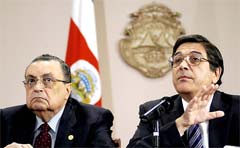
President Abel Pacheco (left)
with Foreign Minister, Roberto
Tovar, at a press conference
discussing Nicaragua's claim to
Guanacaste, a counterattack to
the continuing dispute over
Costa Rica's right to navigate
the San Juan river that divides
the two countries.
|
|
|
|
|
|
|


