|
Hurricane Adrian Slams El
Salvador; Costa Rica Affected
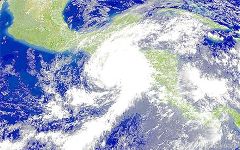
Hurricane Adrian slammed into El
Salvador late Thursday, cutting
off power and unleashing heavy
rains that could cause severe
flooding.
Some 14,000 people were
evacuated as the storm bore down
on the Salvadoran coast.
The eastern Pacific's first
storm of the season hit west of
the capital, San Salvador. It
was the first recorded Pacific
hurricane to strike the country.
Late Thursday, Adrian was
swirling just off the Salvadoran
coast, slightly west of Puerto
La Libertad, the beach resort
and seafood center closest to
the capital San Salvador.
Streets were deserted as rains
sprayed across an increasingly
agitated surf and waves pounded
at the pier.
At least one death was linked to
the storm. A military pilot died
Wednesday when he crashed a
small plane that he was ferrying
from San Salvador's civilian
airport to a military base as a
precaution against the heavy
winds.
The U.S. National Hurricane
Center, relying on data from a
U.S. Air Force reconnaissance
plane, said Adrian had grown to
hurricane force, with maximum
sustained winds of about 140 kmh.
It was moving toward the
northeast at about 15 khm.
El Salvador has no Atlantic
coast, though it suffered when
Hurricane Mitch poured through
after swamping Honduras in 1998.
Mitch, which killed at least
9,000 people in Central America,
was downgraded to a tropical
storm before reaching El
Salvador.
If Adrian maintains hurricane
force, it would be the first
time on record that a Pacific
hurricane had hit the country,
said Antonio Arenas, director of
El Salvador's National Service
of Territorial Studies.
Most Pacific storms spawned off
the Central American coast head
toward the northwest, roughly
parallel to the coastline, then
edge out to sea or veer inland
farther north, in Mexico.
The first hurricane of the
season got closer to the Pacific
coast of El Salvador making it's
way west, forcing the evacuation
of thousands facing heavy rain
and strong winds. Honduras,
Guatemala and Nicaragua is
expected to also be affected.
El Salvador's president, Elías
Antonio Saca, said his country
is prepared for the emergency.
The hurricane also affected
several TACA airline flights,
especially those that has stops
through El Salvador, Guatemala
and Honduras. TACA is based in
El Salvador.
The hurricane is expected to
affect Costa Rica's northwest
province of Guanacaste with
heavy rain and strong winds for
the next several days. The storm
is too far north to directly
affect Costa Rica.
The Comisión Nacional de
Emergencias (CNE) in Costa Rica
has already made preparation for
the heavy rainfall that is
expected, that will also affect
the coastal areas of Puntarenas
and the Central Valley (San
José).
San José woke up this morning
clouded after a heavy rainfall
during the night. The Instituto
Meteorólógico Nacional (IMN) -
the weatherman - forecasts for
the Central Valley much of the
same for the next couple of
days.
|
|