|
|
 CNFL Investing in Wind
Power Generation
CNFL Investing in Wind
Power Generation
Trailer Loses Control,
Two Dead, Eight
Injured As a Result
Zapote Bulls Cost More
Today
The Rush To Get
Home
Green Sea Turtles
Reemerging |
|
CNFL Investing in Wind
Power Generation
The Compañía Nacional de
Fuerza y Luz (CNFL) is
moving closer to
completion its project
to use the wind to
generate electrical
power. For the last five
years The CNFL has been
studying the wind in the
Cerro Pabellón in Santa
Ana.
The mission is to
measure wind velocity to
determine the exact
location of the 18 wind
turbines it will use to
generate 15 megawatts of
power.
The turbines stand 12
metres tall and each can
generates 850 kilowatts
of electricity.
Currently the Instituto
Costarricense de
Electricidad (ICE),
CNFL's parent company,
has wind turbines
installed in Tilarán
that generate 80
megawatts of power. The
Tilarán turbines stand
magestically on top f
the small mountain that
overs looks the Nuevo
Arenal.
The CNFL hopes to have
the Santa Ana turbines,
at a cost of us$21
million dollars,
operational by 2010.
The Santa Ana turbines
will produce enough
energy to supply
electricity to 5.000
homes, some 20.000
people.
For the municipality of
Santa Ana, they see the
project not only for a
way of producing more
electricity, but also as
a tourist attraction,
bringing more tourists
and their spending to
the area.
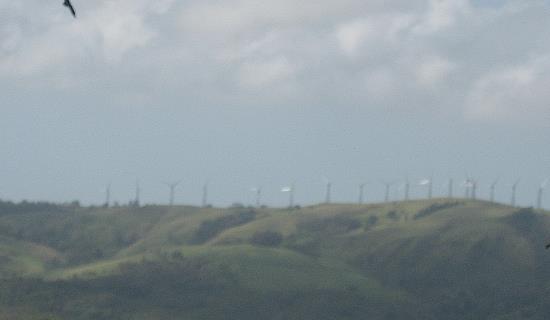
The Tilarán wind
turbines.
Wind power is the
conversion of wind
energy into useful form,
such as electricity,
using wind turbines. At
the end of 2006,
worldwide capacity of
wind-powered generators
was 73.9 gigawatts;
although it currently
produces just over 1% of
world-wide electricity
use, it accounts for
approximately 20% of
electricity production
in Denmark, 9% in Spain,
and 7% in Germany.
Globally, wind power
generation more than
quadrupled between 2000
and 2006.
Most modern wind power
is generated in the form
of electricity by
converting the rotation
of turbine blades into
electrical current by
means of an electrical
generator. In windmills
(a much older
technology), wind energy
is used to turn
mechanical machinery to
do physical work, such
as crushing grain or
pumping water.
Wind power is used in
large scale wind farms
for national electrical
grids as well as in
small individual
turbines for providing
electricity to rural
residences or
grid-isolated locations.
Wind energy is
plentiful, renewable,
widely distributed,
clean, and reduces toxic
atmospheric and
greenhouse gas emissions
if used to replace
fossil-fuel-derived
electricity. The
intermittency of wind
seldom creates
insurmountable problems
when using wind power to
supply up to roughly 10%
of total electrical
demand (low to moderate
penetration), but it
presents challenges that
are not yet fully solved
when wind is to be used
for a larger fraction of
demand.
|
|
|
|
|
|
|
|
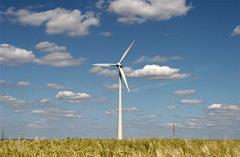
An example of a wind
turbine. This 3 bladed
turbine is the most
common design of modern
wind turbines because it
minimizes forces related
to fatigue. |
|
|
| |
|


