 For Nicaraguans, New Currency Is a Hot
Potato
For Nicaraguans, New Currency Is a Hot
Potato
Panama
Confirms 69 Cases Of AH1N1 Flu; No Deaths
Salvadoran Funes for Stronger Links with
Venezuela
Guatemala First Couple Accused of Murder
For
Nicaraguans, New Currency Is a Hot Potato
By Tim Rogers / Time.com
In a country accustomed to surprises from
its government, Nicaraguans received another
curiosity on May 15 when they awoke to find
that the Central Bank, moving in the night
as stealthily as the Tooth Fairy, had snuck
a new legal tender into their economy while
the markets were sound asleep.
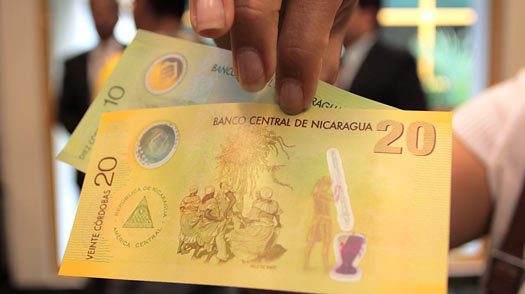
The new bills, printed on a peculiar
plastic-like material in an unfamiliar size
and adorned with never-before-seen designs,
are meant to replace the old, ratty paper
bills that cause germaphobes to collapse in
conniptions every time they are handed
change.
The problem is the new bills were slipped
into the economy without any public
awareness campaign and minimal forewarning.
A week after the plastic money was let loose
on the economy, the Central Bank still
hadn't updated its website to indicate that
the new bills even existed. (See the top 10
public panics!!!)
As a result, most people didn't know what to
think when they were suddenly handed a new
plastic 10 or 20 cordoba bill, the lowest
denominations of Nicaraguan tender and
therefore the most commonly used.
"This looks like European money," says one
taxi driver, in a voice hinting pride, as he
twisted and creased the bill in cruel
defiance of its seemingly indestructible
space-age properties. Others have described
it as "play money" or complain that its
gloss makes it "slip through my hands."
Most of the criticism, however, seems to
indicate an underlying lack of confidence
and trust in the government. There are many
who remember the first Sandinista
government's inventive monetary policies and
the resulting mega-inflation of the 1980s.
As a result, some people are now treating
the new plastic dinero as if it were a hot
potato.
"Many people don't want these bills because
they think they are valueless and they're
going to get stuck with them, so they're
spending them as fast as they can," says
clothing vendor Fabiola Espinoza. It has
unintentionally created a bizarre stimulus
effect on Nicaragua's beleaguered economy.
"As soon as I get one of the plastic bills,
I try to pass it on right away to someone
else," says shopkeeper Gloria Romero.
The public's suspicion of the new bills has
been validated by serious legal concerns by
economists and opposition lawmakers. Several
legislators have pointed out that the new
bills were printed without the signature of
the Minister of Finance, as required by the
country's Monetary Law, effectively making
them fake bills.
"These bills are illegal and worthless and
should only be used to play Monopoly," says
opposition legislative leader Wilfredo
Navarro. "President Daniel Ortega is a
counterfeiter. That's the level things have
gotten to in Nicaragua these days." The
lawmaker, a member of the legislature's
Economic Commission, says "any serious
government" would immediately recognize the
error and recall the money. But so far the
Sandinistas aren't budging.
Instead, government officials have responded
in what has become the Sandinistas' standard
reaction to criticism: triumphalism mixed
with personal attacks. Sandinista lawmakers
have accused Navarro of "economic terrorism"
for questioning the bills' legality, and
Central Bank president Antenor Rosales
dismissed the criticism as the complaints of
rich people "who are more accustomed to
using debit cards and checks and don't care
about the people." Said Rosales, "The
Central Bank is profoundly satisfied with
the excellent reception that the bills have
had with the Nicaraguan population.
Everywhere in Nicaragua the bills are being
used."
Rosales defended the legality of the bills,
insisting that legislation passed in 1995
gives the Central Bank "exclusive authority"
to mint and print money. The number of
signatures that appear or don't appear on
the money is not important, he said.
Critics, however, argue that the Central
Bank's exclusive authority doesn't give it
creative license to invent new styles of
currency that stray from the technical
specifications laid out in the Monetary Law.
"The government couldn't just start
circulating cacao beans and say it's
currency like the indigenous did," says
economist Nestor Avendano. "They have to
respect the law."
The problem in Nicaragua, according to
Liberal Constitutional Party lawmaker
Francisco Aguirre, is that most people don't
know what the laws say, including the
government. "In this country, we pass laws
and we don't know what they say and we don't
care," he says. "This is an outlaw country."
Still, Aguirre predicts, the issue of the
new currency and whether it's legal or not
is a case of a "tempest in a teapot" — an
issue that will fade away as soon as the
inevitable next crisis comes around. (Read a
story about Nicaragua's vampire problem.)
In the meantime, vendors such as Gloria
Romero, whose small corner store sells a
variety of oddities, says she'll hold on to
her old money and keep the plastic bills
moving so she doesn't get stuck holding them
when the music stops. "I prefer to save
these," she says, holding up two grungy
paper notes, and wrinkling her nose in
disgust.
 |
|
|
|
|


