US
Team Takes On Unforgiving Saprissa
Stadium
By Beau Dure, USA TODAY
The U.S. men's team is boldly going
where no U.S. men's team has won
before. Previous U.S. teams to visit
Costa Rica in World Cup qualifiers
haven't even come close.
Heading into tonight's game the U.S.
men have lost six consecutive
qualifiers in Costa Rica.
The USA last took a point from a
Costa Rica trip in 1985 in a 1-1 tie
that John Kerr, who scored the U.S.
goal, admits was a little lucky.
"They overlooked us, which was
naturally because we were very
inexperienced," Kerr says. "They
were unlucky. They hit the post.
They had most of the play, and we
hit them on the counterattack."
That team, mixing a couple of NASL
veterans with college players,
played in Alajuela, not the imposing
Estadio Ricardo Saprissa, which
awaited a similarly inexperienced
U.S. team in 1989.
"In our era, those games were a lot
more difficult to win simply because
our experience and maybe even the
talent level was not what we have
these days," says Washington Freedom
coach Jim Gabarra, who played there
in 1989.
Since then, Saprissa has been an
unforgiving venue for all visitors.
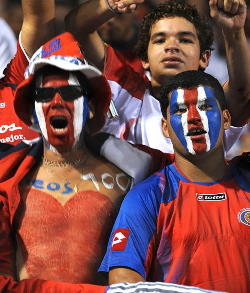
It's commonly called a "cauldron"
for the heat and intensity of fans
who are close to the field and seem
closer, like an old-school college
basketball venue with projectiles
added to the mix.
"They're literally on top of you,"
says Jeff Agoos, who played in a
couple of U.S. losses at Saprissa.
"It feels that they're coming from
all sides. There's this mass of
humanity that surrounds the field."
That mass arrives early. Eddie Pope,
who played several qualifiers in
Saprissa, remembers turning on the
TV in his hotel room a few hours
before an early-afternoon game and
thinking he had found a game to
watch before heading over to the
stadium. He was wrong. The packed
stadium on TV was Saprissa. And it
was live.
By the time the teams get on the
field, the visitors face a storm of
abuse. The words don't hurt, but
batteries, bottles and other objects
can leave a mark. "Coins are a
favorite," Agoos says. "Tim Howard
probably picked up a couple of extra
dollars by being in goal."
Adding to the complications these
days is an artificial surface, which
changes ball-handling and raises the
temperature.
"With all the people there on top of
you, it creates more heat in the
atmosphere," Agoos says. "Now with
the turf field, it's almost
exponentially worse because it soaks
up a lot of that heat from that
day."
"Maybe it's better than a muddy
field, but I don't remember the
field being that bad when it was
just grass," Pope says.
Costa Rica also has had decent teams
over the years, qualifying for the
past two World Cups.
"Not only is the crowd vociferous,
but they're excellent players," Kerr
says.
This year, Costa Rica (2-1) is
second behind the USA (2-0-1) in the
chase for three automatic qualifying
bids. But this team doesn't have
players with the high profiles of
past stars such as Paulo Wanchope
and Hernan Medford.
U.S. coach Bob Bradley is bringing
an experienced, talented squad to
Saprissa, and some of the players
who've been in the cauldron in the
past think this team has a chance to
get out with a point or more,
particularly with an aggressive
approach.
"I would be surprised if (Bradley)
decided to pack it in," Pope says.
"We're the better team. Hopefully
our quality will show through and be
able to settle the crowd down. If
you get on your heels the first
10-15 minutes, you will give up a
goal. It's a dangerous way to come
out and play." |
|