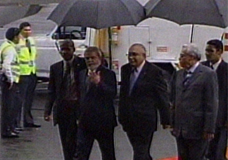
Brazilian President In Costa Rica
For Official Visit
Brazilian President Luiz Inacio Lula
da Silva arrived here Tuesday for
his first state visit to Costa Rica
with an aim to strength the
friendship and cooperation between
the two nations.
"The visit of the Brazilian
president to Costa Rica is due to
the strong will from both countries
to deepen their ties in political,
trade and cultural cooperation at
bilateral and multilateral levels,"
said Vice Foreign Minister Edgar
Ugalde Ugalde, who welcomed Lula at
the airport in San Jose.
Lula will meet with his Costa Rican
counterpart Oscar Arias today
(Wednesday) and a joint declaration is expected
to be signed after their meeting.
He is scheduled to leave Costa Rica
this afternoon.
Luiz Inácio Lula da Silva, known
simply as "Lula" was elected
president of Brazil in 2002 and
after winning re-election in 2006,
his term was extended to 2011.
Lula is the seventh of eight
children and beat the odds of rising
from poverty and little formal
education (he did not learn to read
until he was 10) to becoming the
country's president.
Working as a "shoeshiner' from age
12, he got his first formal job at
14, in a copper processing factory
as a lathe operator. At age 19, he
lost the little finger on his left
hand in an accident working as a
press operator at an automobile
parts factory.
Lula took an interest in the
Worker's Union, participating in
union activities, holding several
important union posts. Brazil's
dictatorship strongly curbed trade
unions' activities, and as a
reaction Lula's views moved further
to the political left.
In 1978 he was elected president of
the Steel Workers' Union of São
Bernardo do Campo and Diadema,
cities in the Greater São Paulo,
home to most of Brazil's automobile
manufacturing facilities (such as
Ford, Volkswagen, Toyota,
Mercedes-Benz and others) and among
the most industrialized in the
country. In the late 1970s, Lula
helped organize major union
activities including huge strikes.
He was jailed for a month, but was
released following protests. For
many years he was president of the
Central Única dos Trabalhadores
(CUT), a union federation that is
strongly influenced by the PT.
On 10 February 1980, a group of
academics, intellectuals, and union
leaders, including Lula, founded the
Partido dos Trabalhadores (PT) or
Workers' Party, a left-wing party
with progressive ideas created in
the midst of the military
dictatorship.
In 1982 he added the nickname Lula
to his legal name.
Lula first ran for office in 1982,
for the state government of São
Paulo. He lost, but helped his party
to gain enough votes to remain in
existence. In the 1986 elections
Lula won a seat in Congress with a
medium percentage of the votes. The
Workers' Party (Partido dos
Trabalhadores, PT) helped write the
country's post-dictatorship
constitution, ensuring strong
constitutional guarantees for
workers' rights, but failing to
achieve redistribution of rural
agricultural land.
In 1989, still as a Congressman,
Lula ran as the PT presidential
candidate. Although he was popular
with a wide spectrum of Brazilian
society, he was feared as an
opponent by business owners and
financial interests.
He continued to run for President in
1994 and 1998.
In the following 2002 campaign, Lula
foreswore both his informal clothing
style and his platform plank of
conditioning the payment of Brazil's
foreign debt to a prior thorough
audit. This last point had worried
economists, businessmen and banks,
who feared that even a partial
Brazilian default along with the
already ongoing Argentine default
would have a massive ripple effect
through the world economy. Lula
became President after winning the
second round of the 2002 election,
held on 27 October, defeating the
Partido da Social Democracia
Brasileira candidate José Serra.
On 1 October 2006, Lula narrowly
missed winning another term in the
first round of elections. He faced a
run-off on 29 October which he won
by a substantial margin. |
|