Monday 11 August
2008, San José, Costa
Rica
 Majority Of
Costa Ricans Reject High Rise Living
Majority Of
Costa Ricans Reject High Rise Living
ICE Contemplating
Offering Services
Outside Costa Rica
Outstripping Tourism
Brazilian Investors
Restricted Spending,
Improved Economy For
2009 Expected
|
ICE Contemplating
Offering Services
Outside Costa Rica
The Instituto
Costarricense de
Electricidad (ICE) says
it is seriously looking
at expanding its
services and compete in
Central America and as
such is currently
studying the different
possibilities.
According to ICE
president, Pedro Pablo
Quirós, the expansion in
the region will not be
as Grupo ICE, but,
rather through
affiliations and
alliances with other
companies, with the
actual role of ICE in
the region will depend
on the results of the
study.
The news comes on the
heels of the signing by
Costa Rican president of
the Ley de
Fortalecimiento y
Modernización del ICE
and now only requires
publishing in the
official government
publication, La Gaceta,
for it to go into
effect.
The Ley de
Fortalecimiento y
Modernización del ICE
permits competition for
cellular and internet
services. Ley General de
Telecomunicaciones
approved several months
ago effectively breaks
the telecommunications
monopoly ICE has had in
the country and
The Ley de
Fortalecimiento allows
ICE to only compete at
home, but it can expand
into foreign markets all
within the framework of
the Tratado de Libre
Comercio (TLC) - free
trade agreement - with
the United States,
Central America and the
Dominican Republic.
Costa Rica is the only
country to have ratified
and put into place the
trade agreement. It is
expected to be approved
and ratified next month
(September), the
deadline Costa Rica
negotiated with the US
and Central America.
Quirós did not explain
what services will be
offered by ICE outside
of Costa Rica, saying
that that all depends on
the study of the market.
Panama is also a market
that for ICE to explore
now that legislative
approval of the Panama -
Costa Rica trade
agreement was given.
under the terms of the
trade deal both
countries can offer
reciprocal
telecommunications
services.
Although ICE remains a
state institution, the
Costa Rican market will
soon see competition for
cellular and internet
services.
The Ley de
Fortalecimiento gives
ICE the tools to prepare
and compete, including
offering additional
services like offering
customers purchase of
equipment and service.
For the first time in
ICE's history, the state
institution will be
offering Blackberry
cellular phones and
cellular services in a
package deal, although
the service is geared
principally to the
business community. ICE
is rumoured to be also
negotiation with Apple
for the introduction of
the Apple iPhone.
Quirós was adamant that
the expansion plans are
only in the study phase
and that any move
outside of Costa Rica
will be through
affiliates, he
reiterated. |
|
|
|
|
|
|
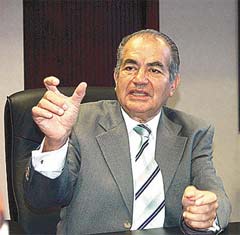
Pedro Pablo Quirós,
president of ICE, wil be leading the state institution
into the new era of telecommunications in Costa Rica and
expansion to other markets. |
|
|
| |
|


