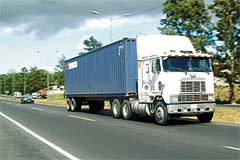
MOPT Announces Plans For Mobile Truck
Inspection Stations
The Ministerio de Obras
Públicas y Transportes (MOPT)
announced that it will
have in place five
mobile truck inspection
stations operating
around the country in
the next three months.
Trucks have been running
free for the last
fifteen years, carrying
their loads mostly
unchecked save for the
watchful eye of Tránsito
officials who do not
count with the tools
necessary to carry out a
proper inspection of
overload and faulty
mechanisms.
The MOPT says it is
waiting on the approval
of the Contraloría
General de la República
(CGR) - Comptroller's
offic - to ratify the ¢2
billion colones contract
it has signed with a
private company.
The mobile inspections
stations will stationed
in specific locations
and can easily be moved
to critical points
around the country at
any time. In addition,
the MOPT says the mobile
stations will operate on
a 24 hour basis.
The MOPT attempted some
five year back to
regulate the trucking
industry by building a
series of fixed truck
stations at key points
outside the Central
Valley on major routes
to the northern and
southern borders, the
routes with the heaviest
tractor trailer traffic.
However, like the
inspection station east
of Esparza on the
Interamerican norte,
they were never
completed and abandoned,
left behind for vandals
to extract all the
valuables from the
almost complete
construction.
The only inspection
station in actual use is
at Sandoval de Limón.
Karla González, MOPT
minister, said that she
cannot allow that trucks
continue to "roam free".
The mobile stations will
ensure that the trucks
are not overloaded,
reducing the risk of
accidents as an overload
can greatly reduce the
effectiveness of the
truck's brakes and
stopping distance.
However, all the work of
the MOPT to ensure that
truckers follow the
regulations are in vain
if the new Ley de
Tránsito (traffic law)
is not approved.
The current fine for a
truck that is overloaded
is ¢10.000 colones
(us$20), not much of an
deterrent. The new
traffic law, however,
would increase the fine
to ¢120.000 colones
(us$242).
|
|