|
|
 Hemorrhagic
Dengue Reaches Epidemic Proportions
Hemorrhagic
Dengue Reaches Epidemic Proportions
Tránsito Goes Hi-Tech
Costa Rica Celebratres
186th Anniversary of
Independence
Smash and Grab Gang Move
Location of their
Attacks
Recope Asks
for A Drop in Gasoline Prices |
|
Hemorrhagic
Dengue Reaches Epidemic
Proportions
According to the
Ministerio de Salud
(Health Ministry),
Hemorrhagic Dengue has
reached epidemic
proportions as 180
people had been infected
as of September 8.
That number is 150%
higher that the number
registered during the
entire year last year,
when 72 people were
treated and a whopping
increase from the 11
cases in 2004.
The situation is
worsened as it is
leaving deaths behind,
as two infants have died
from Hemorrhagic Dengue,
a 15 month old in
Golfito last May and a
eight month old last
week in Limón.
The Ministra de Salud,
María Luisa Ávila Agüero,
confirmed that both
deaths are due to
Dengue.
In addition, the
minister said that her
ministry is
investigation another
nine deaths that could
be resulting from
Dengue, half of which
are in Limón.
Dengue fever and dengue
hemorrhagic fever are
acute febrile diseases,
found in the tropics,
with a geographical
spread similar to
malaria. Caused by one
of four closely related
virus serotypes of the
genus Flavivirus, family
Flaviviridae, each
serotype is sufficiently
different that there is
no cross-protection and
epidemics caused by
multiple serotypes (hyperendemicity)
can occur.
Dengue is transmitted to
humans by the Aedes
aegypti mosquito, which
feeds during the day.
Signs and symptoms
This infectious
disease is manifested by
a sudden onset of fever,
with severe headache,
muscle and joint pains (myalgias
and arthralgias - severe
pain gives it the name
break-bone fever or
bonecrusher disease) and
rashes; the dengue rash
is characteristically
bright red petechia and
usually appears first on
the lower limbs and the
chest - in some
patients, it spreads to
cover most of the body.
There may also be
gastritis with some
combination of
associated abdominal
pain, nausea, vomiting
or diarrhea.
Some cases develop much
milder symptoms, which
can, when no rash is
present, be misdiagnosed
as influenza or other
viral infection. Thus,
travelers from tropical
areas may inadvertently
pass on dengue in their
home countries, having
not been properly
diagnosed at the height
of their illness.
Patients with dengue can
only pass on the
infection through
mosquitoes or blood
products while they are
still febrile.
The classic dengue fever
lasts about six to seven
days, with a smaller
peak of fever at the
trailing end of the
fever (the so-called
"biphasic pattern").
Clinically, the platelet
count will drop until
the patient's
temperature is normal.
Treatment
The mainstay of
treatment is supportive
therapy. Increased oral
fluid intake is
recommended to prevent
dehydration. If the
patient is unable to
maintain oral intake,
supplementation with
intravenous fluids may
be necessary to prevent
dehydration and
significant
hemoconcentration.
Prevention
Primary prevention
of dengue mainly resides
in eliminating or
reducing the mosquito
vector for dengue.
Public spraying for
mosquitoes is the most
important aspect of this
vector.
Personal prevention
consists of the use of
mosquito nets,
repellents containing
NNDB or DEET, cover
exposed skin, use DEET-impregnated
bednets, and avoiding
endemic areas. |
|
|
|
|
|
|
|
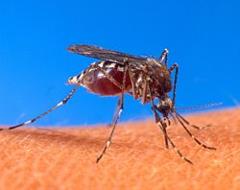
Aedes
aegypti, commonly known as the yellow
fever mosquito, is a mosquito that can
host the dengue fever.
|
|
|
| |
|


