|
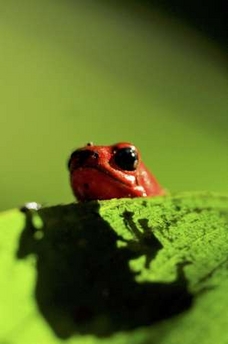
Amphibians Disappear from Costa Rican jungles
Global warming is the top suspect for the
disappearance of 17 amphibian species from Costa
Rican jungles, scientists said on Tuesday,
warning monkey and reptile populations were also
plummeting.
Five of the amphibian species were found only in
Costa Rica, meaning their disappearance from the
country's jungles spells extinction, said Alvaro
Herrero, a biologist with Costa Rica's National
Biodiversity Institute.
Among the now-extinct species is the golden
toad, named for its shimmering yellow colour,
and two varieties of Harlequin frog, identified
by their black and green stripes.
Scientists have yet to identify a precise
mechanism for the disappearance of the
amphibians, which began decades ago, but a prime
suspect is a fatal fungus that has invaded their
habitats, Herrero said.
"It is believed climate change is raising
temperatures allowing a skin fungus to enter the
places where the amphibians resided," he said.
Several studies in recent years have linked the
rapid disappearance of many of the world's frog
and toad species to global warming.
About a third of the 5,743 known species of
frogs, toads and other amphibians are classified
as threatened, according to the Global Amphibian
Assessment survey.
In La Selva, a biological station in northern
Costa Rica run by Duke University's Organization
of Tropical Studies, scientists have found a
75-per-cent decline in amphibian population over
the last 35 years.
|
|