|
|
 Commuter Train A
Success, Planning Additional Runs To
Meet Demand
Commuter Train A
Success, Planning Additional Runs To
Meet Demand
MOPT Minister Promises
to Get Tough With
Corrupt Inspectors
Man Sets Fire To
Hotel After Being Rejected By Prostitute
Electricity Price Hike
Approved
NOAA
Scientists To Search
Tropical Skies For
Answers on Climate
Change
Costa Rica Partnership to Train Hispanic
Ministers |
|
NOAA
Scientists To Search
Tropical Skies For
Answers on Climate
Change
Scientists from NOAA’s
Earth System Research
Lab will be among 400
researchers in Costa
Rica this summer to
probe one of the most
complex and least
observed regions of
Earth’s atmosphere
during the rainy season.
Based in San José, the
NASA-led field study
will shed light on key
processes related to
climate change, the
stratospheric ozone
layer, and global
chemistry.
The study runs from July
2 through August 15.
The Tropical
Composition, Cloud and
Climate Coupling (or
"TC4") experiment will
use a large array of
instruments to observe a
part of the atmosphere
above the eastern
Pacific Ocean eight to
13 miles above the
surface of the Earth
during the rainy season.
This zone is a layer of
the atmosphere nicknamed
the “gateway to the
stratosphere.” The
tropic’s powerful
convective engine drives
water vapor and other
gases and material into
the stratosphere here,
where their impacts may
be global. One
overarching question is
whether this transition
layer will warm or cool
with climate change.
ESRL’s David Fahey and
colleagues from NOAA and
the University of
Colorado will fly
instruments aboard
NASA’s high-altitude
WB-57 aircraft to gather
data on black carbon
particles, ozone, water
vapor and particle
composition, as well as
air pressure and
temperature.
“We’ll be fishing around
in a key part of the
atmosphere at a key time
of year,” said Fahey.
“Casting a wide net and
being open to whatever
comes could lead to
surprising and important
findings.”
Fahey will observe black
carbon, or soot,
produced by fossil fuel
burning. By absorbing
sunlight and heating the
air, black carbon can
change atmospheric
circulation and
precipitation, but the
processes involved are
unclear. For example,
how black carbon
influences clouds and
how clouds remove it
from the atmosphere
remain an unsolved
puzzle. Scientists know
so little about black
carbon that any direct
observations are
important, Fahey said.
On the same aircraft, a
team led by NOAA/ESRL
scientist James Elkins
will measure nearly 20
gases, including
ozone-destroying
chlorofluorocarbons and
their substitutes, the
greenhouse gas methane,
carbon monoxide, and
peroxyacytyl nitrate
(also known as PAN) — a
component of smog at
lower altitudes. Elkins
will track natural and
human-produced PAN as it
moves over land, changes
altitudes, then travels
long distances. It
finally descends over
the ocean, forming
surprisingly high levels
of ozone above the
remote, pristine
Pacific.
Elkins will also monitor
methyl iodide, another
compound with little
known about it.
Depending on the
lifetime of the gas, an
iodine atom can attack
Earth’s protective ozone
layer 200 times more
effectively than a
chlorine atom, the
primary ozone destroyer.
How much methyl iodide
is getting into the
stratosphere and exactly
how it gets there are
unknown.
“Until recently, we
thought oceans were the
only important source of
methyl iodide. Now we
know the Amazon can be a
big source,” Elkins
said. “We now have to
look into what it means
for the ozone layer.”
Among substitutes for
human-made
ozone-depleting
compounds, Elkins will
study HCFC-22. Commonly
used in room air
conditioners, the
compound was introduced
as a shorter-lived,
less-harmful substitute
for ozone-eating
chlorofluorocarbons, but
it’s also a greenhouse
gas. Now levels of
HCFC-22 are rising
rapidly as the demand
for air conditioning
soars in China and
India.
Water vapor, the most
powerful and most
prevalent greenhouse
gas, is a primary focus
of TC4. In the study
layer of the lower
stratosphere, air is far
drier than at the
surface, but the exact
numbers are
questionable. Six water
vapor instruments on
board the WB-57 will
help scientists verify
satellite data and
resolve inconsistencies
found in previous
measurements.
Holger Vömel with the
Cooperative Institute
for Research in
Environmental Sciences
(also known as CIRES), a
partnership between NOAA
and the University of
Colorado will measure
atmospheric water vapor
and ozone up to 17 miles
above the surface with
instrumented balloons
launched from the San
Jose airport. These
measurements will help
resolve discrepancies
between instruments that
measure water vapor,
Vömel hopes to shed
light on cloud formation
and track rising and
sinking air parcels.
The total stream of TC4
measurements from space,
aircraft, balloons and
ground stations will
help researchers
understand their own
data and provide
long-awaited accuracy
checks for satellite
instruments. “Everyone
wants to know how
accurate the satellites
are,” says Fahey. “It’s
incredibly important.”
The National Oceanic and
Atmospheric
Administration, an
agency of the U.S.
Commerce Department, is
celebrating 200 years of
science and service to
the nation. From the
establishment of the
Survey of the Coast in
1807 by Thomas Jefferson
to the formation of the
Weather Bureau and the
Commission of Fish and
Fisheries in the 1870s,
much of America's
scientific heritage is
rooted in NOAA.
NOAA is dedicated to
enhancing economic
security and national
safety through the
prediction and research
of weather and
climate-related events
and information service
delivery for
transportation, and by
providing environmental
stewardship of our
nation's coastal and
marine resources.
Through the emerging
Global Earth Observation
System of Systems (GEOSS),
NOAA is working with its
federal partners, more
than 60 countries and
the European Commission
to develop a global
monitoring network that
is as integrated as the
planet it observes,
predicts and protects.
CIRES is a partnership
between NOAA and the
University of Colorado |
|
|
|
|
|
|
|
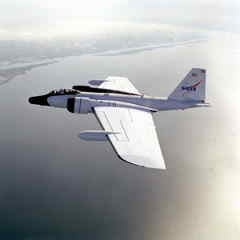
Image of NASA’s high-altitude WB-57
aircraft being used by NOAA and the
University of Colorado to gather
atmospheric data as part of the Tropical
Composition, Cloud and Climate Coupling
(TC4) experiment being conducted from
July 2 through August 15 in the eastern
Pacific Ocean. |
|
|
| |
|


