|
|
 Cellular Lines Go On
Sale Starting Tomorrow
Cellular Lines Go On
Sale Starting Tomorrow
Festival de la Luz
a Success
Criminals Don't
Discriminate Against
Politicians
Stone Sphere Found
Cuban Takes Lead in
Veulta a Costa Rica |
|
Stone Sphere Found
In the final stage of
excavation of the
remains of an Indian
pre-Columbian village in
Palmar Sur, in the Costa
Rican South Pacific, a
National Museum team of
archaeologists, led by
Adrian Bonilla, found a
1.1 meter stone sphere,
in exactly the same
place where it was set
some 1,000 years ago.
The finding was
exciting, particularly
because the last of such
spheres – world renowned
because they are found
only in the area – had
been found in 1994.
According to Bonilla,
the sphere was a symbol
of power.
Stone spheres of
Costa Rica
The stone spheres of
Costa Rica are a
collection of over three
hundred Petrospheres in
the Diquis Delta and on
Isla del Caño of Costa
Rica. Known locally as
Las Bolas, they are also
called The Diquis
Spheres and stone balls
of Costa Rica.
The spheres were
discovered in the 1930s
as the United Fruit
Company was clearing
jungle for banana
plantations. Workmen
pushed them aside with
bulldozers and heavy
equipment, damaging some
spheres. Additionally,
inspired by stories of
hidden gold workmen
began to drill holes
into the spheres and
blow them open with
sticks of dynamite.
Several of the spheres
were destroyed before
authorities intervened.
Some of the dynamited
spheres have been
reassembled and are
currently on display at
the National Museum in
San José.
Numerous myths surround
the stones, such as they
came from Atlantis, or
that they were made as
such by nature. Some
local legends state that
the native inhabitants
had access to a potion
able to soften the rock.
Another claims that at
the center of each
sphere is a single
coffee bean.
It has been claimed that
the spheres are perfect,
or very near perfect in
roundness. However some
spheres are known to
vary by 5 cm (2 in) in
diameter. Also the
stones have been damaged
and eroded over the
years, and so is
impossible to know
exactly their original
shape.
|
|
|
|
|
|
|
|
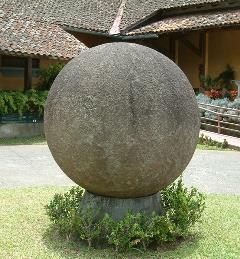
Stone sphere in the
courtyard of the
National Museum of Costa
Rica |
|
|
| |
|


