|
National Emergency Declared!
Following the blackout last week
and more rationing beginning on
Wednesday, the Ministero de la
Presidencia (presidency
minister), Rodrigo Arias,
yesterday declared a state of
emergency as the country faces
an energy crisis.
Arias, brother of Costa Rican
president, Oscar, made the
announcement last night, saying
that the state monopoly on
electrical energy and
telecommunications, the
Instituto Costarricense de
Electricidad (ICE), needs more
latitude to make investment in
generating plants.
ICE's president, Pedro Pablo Quirós,
announced on Wednesday that
continued electric service
rationing is required as the
Cachí reservoir is critically
low and the plant cannot produce
sufficient hydro electric to
meet the current demands and
that the situation will continue
until the rainy season, which
will raise the reservoir water
levels.
ICE set out a schedule of
rotating rationing that is to
affect the entire country
between the hours of 5:00am and
11:00pm, saying that power will
be out for not more than 3 hours
any one location.
However, yesterday's rotation
did not follow any schedules and
many areas, like the Rohrmoser/Pavas/Sabana
area where the ICR offices are
located, power went out at
2:00pm and was not restored
until 8:00pm. Other areas
suffered similar blackouts,
forcing hospitals, like the
Hospital Naciónal de Niños
(Children's hospital) to turn on
its five portable generators
that consume some 500 litres of
diesel fuel each per hour.
Many businesses had to shut down
or operate without any power,
losing sales. Traffic lights at
major intersections became a
nightmare are the Policía de
Tránsito did its best to attend
to as many intersections without
power as possible.
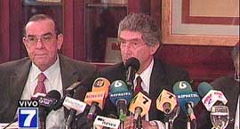
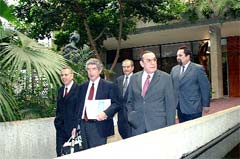
Though the announcement on the
state of emergency was made
yesterday by Minister Arias,
with the Ministro del Ambiente
(Environment Minister), Roberto
Dobles and regulator, Fernando
Herrero, at his side. The
government decree is expected to
be signed sometime this morning.
What the decree does is allow
ICE more agility in making the
required investment to avoid the
power shortages the country is
now facing, said minister Arias.
At first a controversy began to
brew over the timing of the
power failures and the decision
by the regulating authority
denying ICE an increase in
electrical rates. Minister Arias
assures that the problems with
the rate increase are not
related to the "current crisis"
of an energy shortage.
Minister Dobles, explained that
the country has been suffering
from a low investment in
electrical energy. Dobles said
that according to their
information, the energy levels
the current government found
when coming in, were low and
reducing. However, the
technicians at ICE assured that
they were sufficient, but did
not count on four plants
failing.
The problems of last week were
attributed to power plant
failures at Moín (Limón),
Barranca (Puntarenas) and San
Antonio de Belén, in the Central
Valley, The Cachí reservoir
problem became critical this
week.
The problem is that the country
is facing a shortage of some 200
megawatts of electrical energy
to meet the demand.
The state of emergency decree
will allow ICE to fast track the
purchase of between 3 and 5
thermal plants for a cost of
us$150 million dollars. The
plants, allowing time for the
purchase, importation and
installation, would not be ready
for at least eight to twelve
months.
In the meantime, ICE has plans
to for next month to put in
operation the hydro electric
plant at Cariblanco, which will
generate 83 megawatts of power
and with the start of the rainy
season around the corner, the
current hydro electrical plants
will be back to full production
as reservoir levels begin to
rise.
The major problem facing ICE is
one of "tramitología" - best
described as the paperwork and
beuaracracy. The objective of
the ICE executive is to avoid
the messy and cumbersome red
tape.
During the announcement at Casa
Presidencial, regulator Herrero,
added that the Aresep will also
analyze the subject of a rate
increase. Minister Arias added
that in the coming days, ICE
will submit all the
documentation the Aresep is
asking for, along with the
corresponding studies related a
rate increase.
Herrero assured that his
position (the reasons for
denying the rate increase
earlier this week) will not
change following the meeting
with Minister Arias.
|
|