|
OAS
Chief Pledges Support For New
President
The
head
of the Organization of American
States (OAS) José Miguel Insulza
on Tuesday pledged support for
the newly-elected President
Oscar Arias.
"We will try to work with the
Oscar Arias administration as
much as possible," said the
Chilean-born OAS
secretary-general, who attended
Arias's inauguration ceremony on
Monday and was one of the first
guests at the Arias home on
Tuesday.
He said he was interested in
several topics mentioned in
Arias's inauguration speech,
including international
cooperation and reducing
military spending.
Insulza said Arias had asked him
for help in making Costa Rica
more governable. He said the OAS
would support the government in
its bid to make Costa Rica more
open to the outside world and
help it boost public
administration and political
transparency.
"President Arias has begun his
second presidency at an
important moment for the
country. I believe he will be
very successful," Insulza said.
Arias served as president of
Costa Rica from 1986 to 1990.
Moreover, Insulza said Arias won
the Nobel Peace Prize in 1987
for promoting peace talks that
eventually ended civil wars in
Central America and the OAS
might call on him to help settle
disagreements among some South
American nations.
"President Arias is a person
with a great deal of
international standing and he
could help a lot on the
continent," Insulza said.
Currently, Costa Ricans are in a
national debate on whether they
should enter a free trade
agreement with the United
States. The CAFTA trade deal or
Tratado Libre de Comercio (TLC )
as it is known locally, was
signed by the Pacheco
administration but has yet to be
ratified by the Legislature,
while the other Central American
countries have already adopted
the trade deal.
In Latin America, Venezuela is
arguing with Colombia, Peru and
Ecuador, as the countries hope
to reach free trade agreements
with the United States, a move
Venezuela opposes.
Uruguay and Argentina are also
at odds as Uruguay built two
paper mills on the shores of the
Uruguay River, which forms the
border between the two nations.
Buenos Aires said the mills had
posed threats to environment on
the Argentine side.
|
|
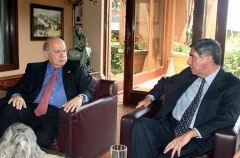
José Miguel Insulza, secretary
general of the Organization of
American States OAS (L), talks
with Costa Rican President Oscar
Arias during a private meeting
in San José tuesday. |
|
|
|
|
|


