|
Bad Drivers Cause of Avoidable
Accidents
Hundreds and sometimes an entire
community pays for the
carelessness of some drivers
who, with impunity, commit acts
of imprudence on the streets
every day.
It is quite common to for a
vehicle to obstruct an entire
intersection or pull a u-turn
and with a Tránsito (traffic)
officials looking on and doing
nothing to penalize the driver.
The evidence is in the number of
tickets issues to drivers for
bad driving.
Between January and May of this
year, the Policía de Tránsito
only issued 64 tickets for
careless driving at an average
of ¢2.000 colones (us$3.90) per
infraction. That figure is for
the entire country.
June figures are not yet
available, but no major changes
are expected.
Other figures that are
disturbing are that during the
period only 10 tickets, again at
¢2.000 colones each, have been
issued for tailgating. And,
another 122 drivers have been
fined between ¢5.000 and ¢10.000
colones for throwing trash out
the car wind\ow.
The low amount of the fines and
the fact that many drivers do
not get fined is an incentive to
drive as you will and have no
respect for the law or other
drivers, let alone pedestrians,
placing lives in danger on a
daily basis.
Another law that is seldom
respected is carrying on a
conversation on a cellular
telephone while driving.
Tránsito officials only gave out
3.274 such fines of ¢10.000
colones each this year.
Germán Marín, director of the
Policía de Tránsito, says that
drivers confident that there
isn't a traffic official around,
don't contemplate about the
dangerous that they expose
themselves to and not to mention
others around them.
"Some people get aggressive when
they get behind the wheel. They
don't identify the risk and
seldom see a traffic official",
said the Marín. Transit director
also admitted that the low fines
is another incentive.
Defending the situation,
director Marín said that the
Policía de Tránsito only has 800
officers for the entire country
and the majority of the officers
are concentrated in the Gran
Área Metropolitana (GAM) - San
José - where there is the
highest density of traffic.
Traffic officers unfortunately
also have to spend an enormous
amount of time at traffic
accidents which stretches their
resources to the limit, Marín
added.
The low fines is a big problem,
according to the Tránsito
director.
That is one of the of the
reasons for the move by the
Ministerio de Obras Públicas y
Transportes (MOPT) to change the
fine amounts established by the
Ley de Tránsito back in 1993.
Viviana Martín, vice-minister of
Transport, added that Ticos
generally consider traffic
accidents unavoidable and part
of daily driving.
"The majority (of accidents) are
avoidable. There are those
drivers who feel empowered at
the time of getting behind the
wheel, in addition to
incompetence because they
haven't received good driving
instructions", said the
vice-minister.
Director Marín added that the
driving instruction and
licensing process is under
review.
Under the current system anyone
can submit to a driving test at
the MOPT offices, which involves
mainly avoiding some pylons, and
be issued a driver's license.
There is no requirement of proof
of driving instruction or the
ability to drive in traffic.
And that is for those who take
the time to take the driving
test. Drivers found driving a
vehicle without a drivers
license are fined ¢10.000
colones (us$19.50), which
doesn't have to be paid until
the actually get a drivers
license. They may also have the
vehicle impounded, something
that rarely happens.
|
|
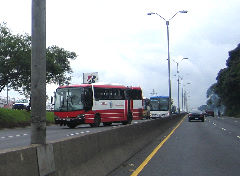
Bad drivers and careless driving
are the major cause of
accidents, accidents that are
avoidable according to the
Transport Vice-Minister, like
the bus in the photo above
backing up on the General Cañas
highway following an accident
the blocked off the road ahead. |
|
|
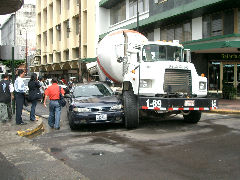
Scenes like this are common on
San José streets, where an
accident can block traffic on an
entire Avenida for hours.
Vehicles cannot be moved until a
Tránsito official and a
INS inspector is on the scene.
|
|
|


