|
Apathy Reigned Over Municipal Elections
With an average of 79.61%,
absenteeism was the big winner
in yesterdays municipal
elections that saw a majority of
the PLN candidates winning the
mayoral races, including
incumbent Johnny Araya in San
José.
The polls opened at 6:00am,
however the majority of Costa
Ricans decided to take in the
hot sunny weather and the Sunday
soccer games than head for the
voting stations.
On the voters list were 2.6
million Costa Ricans who were
asked to choose their municipal
leaders in 81 municipalities
around the country. For whatever
reason, Costa Ricans had little
interest in what the 375 mayoral
candidates had to say in an
election that had no sizzle.
Óscar Fonseca, the president of
the Tribunal Supremo de
Elecciones (TSE)- the body
governing all elections in the
country - said that the
municipal elections should be
spaced farther apart from the
presidential elections and that
could be one of the main reasons
for yesterday's poor voter
turnout.
Another reason cited by Fonseca,
is the lack of government
funding for municipal elections.
Fonseca, said that changes are
needed for the 2010 elections,
otherwise absenteeism will
continue to be high.
"Yes it hurts because the state
made an enormous effort. We have
spent ¢3 billion colones. What
this means is that the major
part of that money is lost",
said the TSE president.
This is the second time that
Costa Ricans get to choose their
municipal leaders directly. In
the first municipal elections in
2002, only 22.8% of the voters
turned, just slightly higher
than yesterday.
The only evidence that an
election was going on was the
prohibition on the sale of
alcohol in bars, cantinas,
restaurants and supermarkets.
When the said and done was over,
the Partido Liberación Nacional
(PLN) - the same party as
president Oscar Arias - was the
big winner, electing 59 of the
81 mayors. All the major cities
- San José, Alajuela, Heredia,
Cartago, Puntarenas and Limón -
elected PLN candidates.
In San José, Johnny Araya begins
his fourth term in office (only
the second to be elected) easily
won over the other 22 candidates
looking to sit in the chair that
he has occupied for the last
fifteen years.
Alajuela, with the second
largest population, former
legislative deputy,
Joyce Zürcher, was given the
chance to govern.
Araya displayed his pleasure for
the support he received and said
he would start to work
immediately in combating some of
the problems plaguing the city,
especially vandalism and drug
addiction.
"I believe the most urgent is
the security of the citizens, a
problem that can not only be
attended to by the Municipality
of San José, but with the
efforts of the Ministerio de
Seguridad Pública, the OIJ,
Migración and the Policía de
Control de Drogas", said Araya.
Araya added that he will push
for a reform to the Código Penal
(Penal Code) to punish
delinquents in San José and that
do not go to jail. "It is not
possible that we cannot punish
harshly delinquents that today
enjoy total impunity, a product
of a legislation that permits
professional delinquents as long
as they stay below a certain
amount without having their
liberty threatened", were the
words of Araya.
In Costa Rica, petty criminals
are taken into custody and
quickly released and in some
cases police do not even bother
to take them in, releasing them
immediately, avoiding the amount
of paperwork associated with a
crime that will go unpunished.
Araya has been on temporary
leave from his mayoral duties
during the election, saying that
he will be back at his desk this
week.
The newly elected
municipal leaders will take
office on 5 February 2007.
|
|
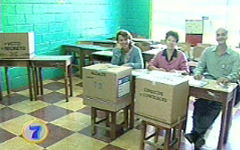
Empty voting stations was the
norm yesterday as Costa Ricans
preferred the soccer games and
the nice weather to the
municipal elections. |
|
|
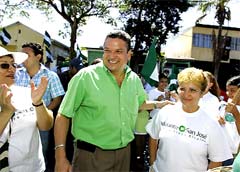
Johnny Araya was re-elected as
mayor of San José, beating out
his 22 competitors. This will be
the fourth term for Araya, but
only the second to be elected.
Get all the election results
here. |
|
|


