|
Nicaragua Blames Ticos For
Energy Shortage
A report in Saturday's edition
of Nicaragua's leading
newspaper, La Prensa, places the
blame on Costa Ricans for the
energy shortage the country is
suffering, as it rations
electrical power.
La Prensa says that the
Instituto Costarricense de
Electricidad (ICE) - the Costa
Rican monopoly on energy and
telecommunications - for buying
up all the cheap energy in
Panama, forcing Nicaragua to buy
electricity from Honduras and
Guatemala at more than double
the price.
Panama sell electrical energy at
between us$70 and us$80 per
Megawatt hour, while Honduras
and Guatemala sells at us$150.
The charge by Nicaragua's
president of the Comisión
Nacional de Energía (CNE),
Ernesto Espinoza Maradiaga, is
that ICE is obstructing the flow
of energy that has to pass
through Costa Rica to get to
Nicaragua.
The flow of electrical energy in
Central America is managed by
the Ente Operador Regional (EOR),
that is charge of the flow of
energy between the Central
American countries and the
Consejo Regional de la Industria
Eléctrica (CRIE), which
functions as a regulator for the
region.
The line of flow currently in
use can carry a maximum load of
60 Megawatts and according to
Maradiaga, the Ticos are using
it all up and there is nothing
left for Nicaragua.
The new Sistema de Interconexíon
Eléctrica para los Países de
América Central (Siepac) will
not be online until 2008 at
which time the flow of energy,
north or south, will be up to
300 Megawatts.
The Nicaraguans say that Costa
Rica is purposely absorbing the
Panamanian energy, energy that
it does not need to buy, rather
it can produce.
Enrique Kuang Sauning, Director
de Electricidad INE (Nicaragua's
equivalent of ICE) said that
according to their information
by the regional regulator, ICE
is not allowing the energy to
flow north due to maintenance in
their energy grid, work that
began at least five days before
the shortages in Nicaragua.
However, the INE director, has a
different opinion. Kuang was not
shy to say that the maintenance
work by ICE is just a ruse to
stop the cheap energy flowing
north.
Kuang added that it won't be
until the end of August when
Nicaraguan officials can really
find out what is the Costa Rican
situation, when the discussion
will be tabled at a meeting of
the CRIE. At the meeting
the Nicaraguans can know ICE's
position on their purchase of
Panama's energy.
In the meantime, Nicaraguans are
living in the dark and without
water. Yesterday, Nicaraguans
took to the street of Managua to
show their discontent at the
government's inaction to solve
the problem.
The INE has set a policy of
supplying electrical fluid to
all parts of the country for a
period of only 16 hours daily,
rationing its available energy.
The supply of water is also
effected by the electrical
energy rationing as pumps shut
down and stop the flow of the
vital liquid during the
blackouts.
|
|
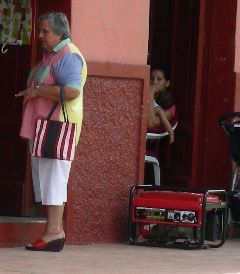
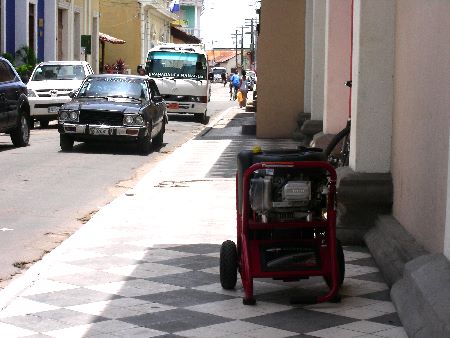
Portable generators keep
businesses running in Granada in
the face of daily electrical
power shortages. |
|
|
Power Outages Are A Daily
Occurrence in Granada
Inside Costa Rica visited
Nicaragua over the last couple
of days. Our visit was of
the tourist town of Granada
where a large number of North
American and European tourists
visit each year.
On Friday, electrical power was
cut at 7am sharp, the flow of
water stopped as well.
Within minutes the whirring of
portable electrical generators
took over the entire downtown
area, as businesses turned on
their generators to keep
operations as normal as
possible.
Hotels and businesses who did
not have a generator, managed
the best they could until the
flow of electrical power
returned at 3pm.
The same was on Saturday,
however, the blackout was
shorter, power returning by
noon.
Residents of Granada say the
have now accustomed to the power
shortages and have altered they
living style around the
blackouts.
Any hope of things changing
soon? Most said no. This is now
things are done in Nicaragua and
what can we (the people) do
about it.
|
|
|