|
Poás
Shows Off
The Volcán Poás national park
re-opened yesterday as it had
been announced, following a week
of being closed. The volcano
erupted on Friday March 24 after
12 years being dormant. Experts
and scientists watched the
volcano closely as it continued
eruptions for several days and
then stopped.
The decision to re-open the part
to the public on Saturday came
after the volcano had calmed
down. Yesterday, some 300
visitors - mostly foreigners -
were at the park to see first
hand what all the fuss was
about.
Like the volcano new that it had
visitors looking on, at 11:17am
it launched a small eruption of
gases in front of the curious
and admirers. The eruption was
mild, nothing like that
eruptions of the week earlier.
Experts fear that crater lagoon
may soon dry up - not a good
thing. The temperature is now
hovering in the 56 Celsius
(132.8 Fahrenheit). Normal water
temperature is 39 Celsius (102.2
Fahrenheit), according to park
director, Juan Dobles Zeledón.
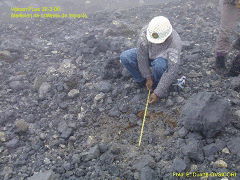
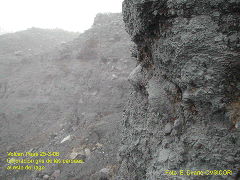
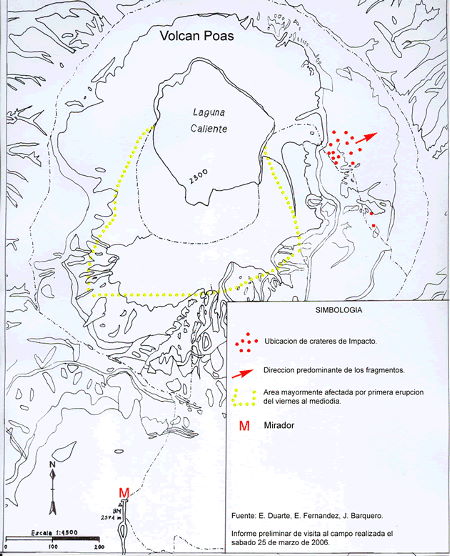
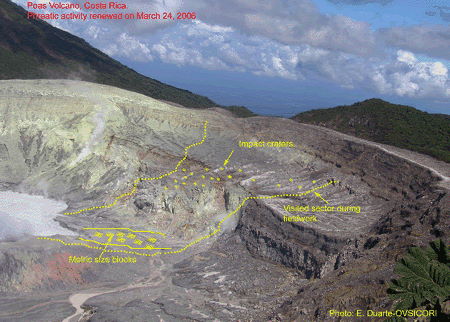
During the first few days, the
volcano erupted 15 times,
spewing gases and rocks that
forced the closure of the park
to the safety of visitors and
workers.
Dobles said the volcano is now
quiet and the park will operate
between 7am and 3pm. Visitors to
the crater will be permitted in
groups of up to 50 persons. No
children will be allowed near
the crater look-point and will
be allowed to stay up to only 45
minutes.
Dobles added that a team of
experts is keeping a close eye
on the volcano and the park
could be closed off again at any
moment if the situation warrants
it.
Experts at Red Sismológica of
the OVSICORI cannot predict how
long it would take for the
crater lagoon to dry up, only
will say that there is a strong
probability that it will.
Eliécer Duarte, a volcanologist,
says that would not be the first
time, saying that during the
1989-1990 and 1994 eruptions,
the lagoon disappeared.
Duarte added that it can take
from a few months to a year for
the crater lagoon to dry up.
"The eruptions have caused the
opening or cleaning of conduits
for gas to escape more easily
and the increase temperature
allow for the water to evaporate
faster", said Duarte.
|
|