|
Experts
Investigating Mysterious Monkey
Deaths
Biologists and veterinarians are
baffled by the death of more
than 3,000 monkeys of various
species at a remote national
park in southwestern Costa Rica.
The deaths of the spider,
white-faced capuchin, howler and
squirrel monkeys occurred over
several weeks late last year in
Corcovado National Park,
prompting Costa Rican and U.S.
scientists to launch an
investigation.
Eduardo Carrillo, a scientist at
the National University of Costa
Rica, told the press that
between 30 and 40 percent of the
monkey population at the park -
home to some 10,000 primates -
had died, probably from a
disease, though the nature of
the illness remains a mystery.
He said the deaths of the
monkeys "are a warning signal
for all of us, so we take into
account that some protected
areas are isolated," adding that
it was necessary to increase
economic support and bolster
research efforts in those areas.
Carrillo and Grace Wong, another
researcher, last week collected
blood samples from monkeys in
different sections of the park,
which will be sent on to the
University of Texas for analysis
by colleagues there.
The most accepted hypothesis is
that an illness that entered the
country from outside is
responsible for the deaths,
although it will take a couple
of weeks for the results of the
blood tests to be ready.
For his part, Corcovado National
Park director Eliecer Arce said
that another hypothesis being
considered is that lack of food
brought on by excessive rainfall
during the 2005 rainy season
caused the deaths.
The staple of the monkeys' diet
is wild fruit, tender leaves,
flowers, insects and small
vertebrates, food sources that
may have been in scarce supply
in Corcovado due to the copious
rainfall.
However, Carrillo said that,
although that possibility is
still under consideration, it is
regarded as less likely than the
disease hypothesis.
|
|
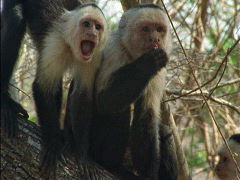
White-faced capuchin capuchin -
Cebus capucinus
A cream and black capuchin monkey living in groups in the forests of
Central and South America, from Belize south to North and West
Colombia.
Life span: 44 or more years in captivity.
|
|
|
|
|
|
|


