|
TLC Protest A Success, Say
Union Leaders
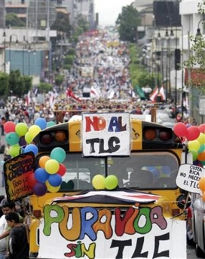
Organizers expected 10.000,
however, more than 20.000 joined
forces yesterday on the streets
of San José to protest the
Tratado Libre de Comercio (TLC)
- the Central America Free Trade
Agreement (CAFTA) with the
United States, after it being
sent to the Legislature to be
ratified.
President Pacheco, after months
of stalling, decided that the
document should go to the
Legislature, saying it was his
duty and obligation.
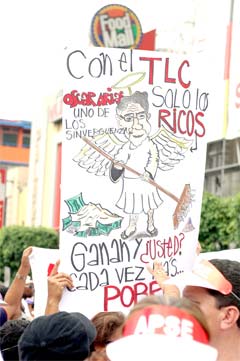
Unions, public employees,
students, teachers, farmers,
housewives and many other
sectors are against the TLC and
yesterday was the first a number
of planned protests to show the
lawmakers of their solidarity
opposing the agreement.
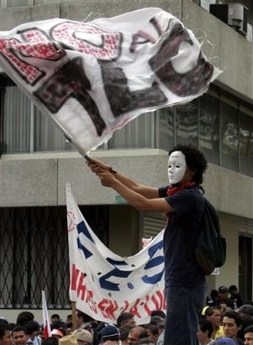
The downtown streets with filled
with protestors who marched to
the drums and flags, unified, in
telling the country's
legislators not to ratify the
agreement, not to sell out Costa
Rica.
Albino Vargas, secretary general
of the Asociación Nacional de
Empleados Públicos y Privados (ANEP)
called the march a "total
success". Vargas added that a
study by the mathematics
professors of the Matemática de
la Universidad de Costa Rica
(whose name he couldn't
remember) estimated the crowd at
60.000. Others were more
reserved, saying 30.000. Based
on past demonstrions, the figure
was really close to 20.000,
double of what had been expected
by the organizers of the
protest.
In addition to union leaders,
leaders of the Movimiento
Libertario (ML) party gathers in
front of the Legislative
building to show support for the
movement. The ML has in the past
ridiculed the protest marches,
prompting union leaders to call
out "where are the four cats
(referring to the ML leaders)
now?"
One group gathered in front of
the Instituto Costarricense de
Electricidad (ICE) building in
the Sabana, west of San José,
while another group gathered in
front of the ICE building in San
Pedro, east of San José, south
of the San Pedro Mall. Both
groups left at 10am to meet
downtown and joining forces,
headed for the Legislative
Assembly building and Avenida
Central.
"The trade agreement serves no
one save the capilalists, which
will leave Costa Ricans hungry
and poor", were one of many
chants and screams of protest
coming from the loudspeakers.
Henry Mora an economics
professor of the Universidad
Nacional said that yesterday's
protests is a small
representation of the opposition
to the TLC.
Opposition questions the wording
of the agreement that was signed
by the central American
governments and the United
States in August of 2004. All
the other Central American
countries had the agreement
ratified by their respective
legislators, save Costa Rica.
President Pacheco defending his
stalling and earlier refusal to
the send the trade agreement tot
he legislature unless the Tax
Reform package was passed, said
that United States president
Geroge W. Bush told him to take
his time. The two met earlier
this month at the Americas
Summit in Argentina.
Although organizers had said
that the protest would paralyze
the country, however, outside of
downtown San José, life was
normal. ICE offices, as well as
other governmnet insitutions
were open, though only a
skeleton staff was on hand to
provide services. The ICE
building in San Pedro was
completely closed off by
demonstatros, shutting down
operations there, including the
113 directory service.
A call to 113 yesterday was met
that the call could not be
completed. Some cellular users
complained of sporadic call
dropping, though that could have
been just a coincidence. A call
to 116, the international
directory assistance, the
operator told ICR that she did
not participate in the strike
because she could not afford
having her pay docked the day
and since 116 operations were
not in either of the East and
West buildings, she and many
others chose to stay on the job.
|
|