|
Costa Rica Reaps Harvest of
Non-Military Policy
By Yoon Won-sup, The Korea Times
Costa Rican Ambassador to Seoul
Pedro Hernandez said his country
is ready to attract Korean
businessmen who are eager to
make inroads into markets in
Latin America and the United
States.
``Among other things, we have
high skilled and educated
workers in Costa Rica,’’
Hernandez said. ``Korean
investors will very much like
them for their high
capability.’’
The 61-year-old ambassador went
on to say that political and
societal stability also make for
a favorable environment to do
business in the Central American
country.
``In addition, Costa Rica
provides very strict legal
system under which all the
contract is guaranteed to be
correctly implemented,’’ he
continued. ``Plus,
geographically, it is a gateway
to North America, South America
and Europe,’’ he added.
Hernandez stressed that the
above-mentioned
business-friendly environment is
mainly due to the Costa Rican
government’s historic decision
to totally dismantle the
military in 1948.
``Costa Rica has not had
military forces like tanks since
1948 because keeping armed
forces costs very much and more
importantly we don’t have
enemies,’’ he said.
The envoy said the money, which
had been spent for maintaining
military forces, has since been
used for health and education of
the public.
The medical
doctor-turned-diplomat happily
showed statistics indicating
that his country is well
advanced in the area of health
and education.
As of this year, life expectancy
was 74.2 years for men and 79.5
years for women, and the
illiteracy rate covering those
aged over 14 was 4.7 percent, he
said.
``Now we are collecting the
harvest of the non-military
policy,’’ he said with a smile.
``We showed the world that a
democratic nation could do well
without military forces.’’
The ambassador was very proud
that his country has suffered
from coup d’etat only three
times since 1821 when Costa Rica
gained independence from Spain.
Moreover, Costa Rica signed free
trade agreements (FTAs) with
various countries including
Chile, Mexico, Canada and the
Dominican Republic, from which
the ambassador said Korean
businessmen in Costa Rica will
get benefit.
``Costa Rica already discussed
the FTA with the U.S., and it
will be signed in the near
future,’’ he said. ``Then, Costa
Rica will offer a perfect place
for foreign businessmen to
export their goods to the U.S.’’
Hernandez, who arrived in Seoul
as ambassador in February 2003,
said he was very surprised by
the huge changes in Korea from
when he had visited here 30
years ago.
He majored in health
administration in Nagoya
University in Japan, and visited
Pusan, Seoul and Kyongju during
his summer vacation in 1975.
``The captain of the ship from
Japan to Korea told me that I
was the first Costa Rican on
board,’’ he said.
The ambassador still remembered
his trip to Kyongju well, where
he had visited Pulguk-sa Temple
and the Sokkuram Grotto.
``I spent two days in Kyongju to
see Pulguk-sa Temple and the
Sokkuram Grotto,’’ he continued.
``Those were very lonely place
without cars and travelers.’’
Recently, Hernandez visited
Kyongju again to see the
Buddhist temple but he found
many things changed. For
example, a Korean house where he
had slept disappeared and
Kyongju was crowded with
tourists.
The ambassador, who is well
aware of Korean history, said he
liked the way Koreans work and
reported to his government that
Costa Rica also should do what
Koreans does.
``We’d like to learn the
Korean-style of work, so-called
`ppali-ppali (hurry up),’’’ he
said. ``We have to hurry up
because we don’t want to stay
behind in this globalized age.’’
He noted that that spirit must
have been the reason behind the
miraculous economic growth of
South Korea in the relatively
short period of time.
Hernandez said that the Costa
Rican government will build a
Korean park in the capital city
of San Jose soon as the Costa
Rica Plaza was inaugurated in
Seoul last December.
The Costa Rica Plaza was built
at World Cup Stadium in Mapo-gu,
western Seoul, where the Costa
Rican Embassy is situated.
|
|
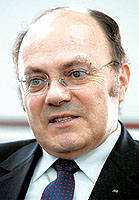
Costa Rica's Ambassador to
Korea, Pedro Hernandez. |
|
|
| |
|
|
|