|
Alcohol and Speeding Focus of
Transit Police Operation During
December
Beginning last night (December
1) the Policía de Tránsito
(traffic police) have begun
their yearly battle against
drunk driving and speeding, with
traffic blocks and spot checks
and 750 officials, almost the
entire police force, will be on
hand.
Alcohol and high speed are the
two main causes of deaths of
Costa Rican roads and during the
holiday season, the situation
gets worse, though numbers show
a decrease in the number of
deaths.
Figures released by Tránsito
show that there were 251 deaths
on the roads up to November, 38
less than the same period last
year.
Transit police will focus their
attention to areas of bars, like
in Escazú, San Pedro and Heredia.
In the past, police have blocked
an entire road, including the
autopista in Ezcazú, to ensure
that every driver coming out of
the bars will pass through the
spot checks, which can include
up to 50 officers.
Another concern and cause of
many accidents, some fatal, are
the traffic jams around malls
and shopping centres.
Another focus for the Transit
police is the use of "official"
vehicles by public employees who
are tempted to take out the
'company' car for their personal
use.
And, in a change from the past,
the Transit police will also
operate spot checks during the
day and submit drivers who are
suspected of being inebriated,
to a breathalyzer test,
according to Tránbsito
sub-director, Huanelge Gutiérrez..
The holiday operation will cost
the Transit police and
additional ¢47 million colones
(us$95.500 dollars).
The operation will run until
January 2.
- - - - - - - - - - - - - - - -
- - - - - - - - - - - - - - - -
- - - - - - - - - -
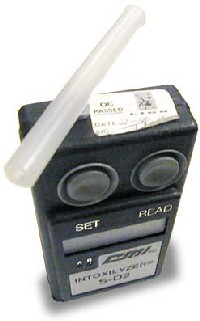
Breathalyzers
Alcohol intoxication is legally
defined by the blood alcohol
concentration (BAC) level.
However, taking a blood sample
in the field for later analysis
in the laboratory is not
practical or efficient for
detaining drivers suspected of
driving while impaired or
driving under the influence.
Urine tests for alcohol proved
to be just as impractical in the
field as blood sampling. What
was needed was a way to measure
something related to BAC without
invading a suspect's body.
In the 1940s, breath alcohol
testing devices were first
developed for use by police in
the United States. In 1954, Dr.
Robert Borkenstein of the
Indiana State Police invented
the Breathalyzer, one type of
breath alcohol testing device
used by law enforcement agencies
today.
Principle of Testing
Alcohol that a person drinks
shows up in the breath because
it gets absorbed from the mouth,
throat, stomach and intestines
into the bloodstream.
Alcohol is not digested upon
absorption, nor chemically
changed in the bloodstream. As
the blood goes through the
lungs, some of the alcohol moves
across the membranes of the
lung's air sacs (alveoli) into
the air, because alcohol will
evaporate from a solution --
that is, it is volatile. The
concentration of the alcohol in
the alveolar air is related to
the concentration of the alcohol
in the blood. As the alcohol in
the alveolar air is exhaled, it
can be detected by the breath
alcohol testing device. Instead
of having to draw a driver's
blood to test his alcohol level,
an officer can test the driver's
breath on the spot and instantly
know if there is a reason to
arrest the driver.
Because the alcohol
concentration in the breath is
related to that in the blood,
you can figure the BAC by
measuring alcohol on the breath.
The ratio of breath alcohol to
blood alcohol is 2,100:1. This
means that 2,100 milliliters
(ml) of alveolar air will
contain the same amount of
alcohol as 1 ml of blood.
There are several different
devices used for measuring BAC.
|
|