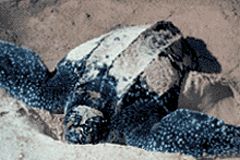
|
Turtle Tourism Beckons
By Rayne Wolfe, The Press
Democrat
As a tourist to Costa Rica more
than a decade ago, Santa Rosa
Junior College instructional
assistant Debbie Sherman
delighted in visiting Tortuguero
National Park, home to many
species of turtles.
Little did she know what was
being set in motion.
"Year after year, I kept going
back to visit Costa Rica, to see
the turtles," she said of the
leatherback and greenback
aquatic reptiles.
On a day trip to the peninsular
village Parismina, she was
shocked when she saw the
beautiful beach littered with
just-butchered turtle carcasses.
"For generations, turtle meat
and turtle eggs have been part
of the people's diet. I respect
the local traditions, but I was
horrified to discover that
poachers illegally killed
turtles to make money," said
Sherman.
Quick research by Sherman
revealed that in the past 20
years, leatherback turtles, the
largest turtles in the world,
have declined by 95 percent,
putting them on the brink of
extinction.
And so she developed a network
of Parismina villagers and
tourists like herself to
voluntarily patrol beaches at
night to discourage poaching.
Led by paid native guides and
with backup from the local Coast
Guard, she says, the effort is
not dangerous.
"What we've found is that with
local support, just standing
there is enough to deter
poachers," she said.
Leatherback season in Costa Rica
is now, April and May. Greenback
season is August through
September, Sherman said. During
these times, the turtles come
out of the ocean at night to lay
eggs on their natal beaches. It
is a time when they are
particularly vulnerable.
The nonprofit group Save the
Turtles of Parismina hopes to
avoid a repeat of last year,
when guide salaries dried up in
mid-September. That's why board
members are hustling for
support.
"Every silent auction item
donated, every ticket purchased,
every dime goes straight into
the program," said Jane
Sorensen, the board president.
Longtime friends, Sherman and
Sorensen are newcomers to
nonprofit organizing.
In one way, their job is simple
- do what they can to protect
turtles. In another way, the
complexity of the effort takes
some explaining.
Monitoring the group's Web site,
www.costaricaturtles.com,
Sherman assists online would-be
travelers in planning trips to
Parismina. Those tourists are
introduced to villagers she has
screened, who open their homes
as lodgings for about $20 a day.
Ideally, turtle-tourism
volunteers who provide room fees
will bolster a poor economy
while reducing poaching.
"This is not glamorous at all.
It appeals to a certain
adventurous type of traveler,"
Sherman said.
Volunteers also guard hatcheries
where eggs are protected until
turtles emerge. Volunteers
shepherd tiny turtles on their
slow first trek to the sea. The
surf then slowly washes away the
lacelike tracks, but, Sherman
hopes, not before symbolically
connecting the people on the
beach to the turtles in the sea.
Save the Turtles of Parismina is
hosting its first benefit
concert to support the beach
patrol work in Costa Rica.
"I know everyone gets these
requests to save this and save
that, the constant gimmie,
gimmie, gimmie, for so many good
causes," she said. "But turtles
are like the blind man heading
toward traffic. Anyone with a
heart would do what they can."
|
|