|
Beach safety risks, passport
thefts prompt U.S. officials to
visit Guanacaste
By Rosibel Perez, Special from
the El Independiente
The lack of information on
safety risks at the beach, the
numerous robberies of tourists’
passports and the new system for
granting visas to Costa Ricans
seeking to visit the United
States resulted in a recent
visit to Guanacaste by U.S.
officials.
The tragic case of the four
young students from the United
States who recently drowned at
the beach Dry Wood of Parrita,
Puntarenas, was so distressing
that Consul Nicholas J. Manring
and Consul employee Virginia
Aguilar paid a visit to Liberia.
They explicitly tried to inform
tourists of the possible dangers
of the beautiful Costa Rican
beaches.
“Tourists who visit Costa Rica
don’t have information about the
risks involved in coming here,”
warned Manring.
The signals that indicate a rise
in the level of risk at the
beaches are largely unavailable
to tourists and the general
public.
Also the robbery of passports
and documents is another danger
that may be experienced by
tourists, who already constitute
approximately 37 percent of the
total population of Guanacaste:
more than 264,400 short-and
long-term visitors.
Costa Rica has the highest
number of American passport
robberies, the primary reason
why the Embassy has been handing
out information cards in the
airports. These small leaflets
specify that it is permissible
to leave one’s passport in a
safe-deposit box in the hotel,
but it is necessary to carry a
copy of the passport photo page
and the page with the
immigration seal.
“The loss and robbery of
passports is generally a result
of crime rings,” added Aguilar,
an investigator of frauds in the
consular section of the United
States Embassy.
American tourists can call the
U.S. Embassy at any time during
the day, including nights and
weekends. Questions of any kind
also can be sent via e-mail to
the Embassy.
Additionally, the Embassy’s web
site lists security parameters
to better prepare travelers for
their visit to Costa Rica.
A large increase in visa
requests by Costa Ricans seeking
to travel to the United States
also has Manring concerned. He
is trying to inform those
interested in obtaining a visa
about the numerous changes in
the way visas are being granted.
Since the beginning of June,
obtaining a visa has become a
more difficult process. First
one must buy a personal
identification number or PIN at
Banco Nacional de Costa Rica.
The PIN activates in 24 hours,
and with that number a person
can call to make an appointment
with the visa office, which will
ask for both the PIN number and
passport data.
Each PIN is valid for only eight
minutes and can be used for five
members of the same family. The
visa applicant must call the
U.S. Embassy immediately upon
receiving the number.
In 2004, the demand for visas
reached 42,000 requests, and in
2005 increased to 55,000. For
the current year, 2006, requests
for visas already have reached
26,000 and counting, according
to data provided by Manring.
Another one of the U.S.
Embassy’s goals is to have a
better building with more space
and to hire several more people
to make the visa process,
particularly the interviews,
speedier and easier. The
probability of successfully
obtaining a visa for people who
are interviewed is 80 percent.
However, this rate varies
greatly based on the type of
visa that is desired. The
tourist visa is the most common.
To obtain a tourist visa, one
must show bank accounts,
personal savings, income
reports, possessions, passport
and other official documents and
their connections to Costa Rica
(this could include family,
investments or work).
In case of an emergency, the
visa appointment can be advanced
when it involves the following
situations: urgent medical
treatment in the United States,
to visit a close relative who is
ill, to attend the funeral of a
close relative, or to attend
business meetings or conferences
scheduled before the obtained
appointment.
In order for a successful
appointment, Manring commented,
“Pretend it’s like a little
chat. You don’t have to be
tense, just tell us your plans.”
|
|
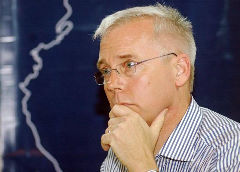
Consul Consul Nicholas J.
Manring answers questions
regarding the new Visa system
and tourist security
|
|
|
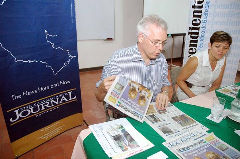
As the number of passport thefts
increase, Consul Nicholas J.
Manring and Consul employee
Virginia Aguilar visited Liberia
and many other Guanacaste cities
to warn travelers.
|
|
|


