|
Habitat for Humanity Builds Hope
As Well As Homes
By Johanna Sevier, Journal Staff
Writer
In an impoverished neighborhood
near Santa Cruz, Karla Rodriguez
Juarez and her two daughters
lived with six other people in a
tiny house with inadequate
electricity, minimal flooring
and no doors.
With the assistance of Costa
Rica’s Habitat for Humanity, the
Rodriguez family moved into an
immaculate three-bedroom home.
In their new home, the family’s
standard of living is vastly
improved. Moreover, the
Rodriguez children no longer
feel embarrassment when their
friends come over to play.
The Rodriguez family is the
first in their neighborhood to
benefit from the assistance of
this non-profit, Christian
housing ministry. Habitat plans
to construct an additional 11
homes near the Rodriguez’s new
residence, which is located in
the small town of 27 de Abril.
Throughout Costa Rica, families
are lifted out of squalid living
conditions with Habitat’s
assistance. By building and
renovating houses, the
organization works in
conjunction with families to
build hope for the future.
Founded in 1976 by Millard and
Linda Fuller of the United
States, Habitat serves as an
international leader in
addressing low-income housing
needs. The organization aims to
create a world where everyone
resides in a decent home. By
working to achieve this
objective, Habitat increases
awareness regarding homelessness
and inhumane living conditions.
Habitat established its first
Costa Rican affiliate in 1988.
Operations were halted after the
government introduced an
ambitious, low-income housing
program in 1991. Cutbacks left
the program poorly funded,
causing Habitat to resume
operations in Costa Rica in
1996. To date, Costa Rica’s
Habitat for Humanity has
completed over 650 homes for
3000 people.
Habitat is not purely a charity,
according to Vivian Burbon,
communications coordinator for
Costa Rica’s Habitat for
Humanity. In fact, Habitat
encourages housing recipients to
act as partners. The families
invest hundreds of hours in
labor in the construction or
renovation of their homes,
referred to as “sweat equity.”
In addition, families must pay
for the homes.
“By helping to construct and pay
for their homes, the families
value what Habitat gives to
them,” explained Burbon.
Unlike homes purchased at market
value, Habitat homes are
affordable for low-income
families. Volunteer donations of
materials and labor and a simple
construction process reduces
construction costs. Moreover,
housing recipients pay for the
homes with long-term, affordable
monthly mortgage payments.
To acquire a Habitat home,
families file applications with
affiliates located in Esparaza,
Nicoya, Monteverde, San Ramon,
Buenos Aires, and Rio Claro. The
affiliates choose participants
based on need, willingness to
become partners in the program
and ability to repay the loan.
After being selected, families
participate in a simple,
standard construction process.
Homes are built with either
concrete blocks or Habicon.
While a concrete block home
requires a six-week construction
period, a Habicon home takes
only one month to build.
Developed by the Costa Rican
Building Research Center at the
Technological Institute of Costa
Rica, Habicon is a prefabricated
construction system designed to
be affordable, environmentally
friendly and earthquake
resistant. A Habicon home
consists of a wooden frame held
together by steel, with concrete
panels and mortar covering walls
and floors.
Despite the work conducted by
Habitat, Costa Rica’s lack of
affordable family housing
continues to grow. An estimated
170,000 housing units are needed
to end the nation’s housing
deficit, according to Habitat.
Moreover, approximately 240,000
homes in Costa Rica demand
qualitative repair.
As a non-profit organization,
Habitat relies heavily on
outside assistance and
donations. Although many Costa
Rican businesses and schools
assist the organization,
foreigners primarily serve as
Habitat volunteers.
For more information, contact
[email protected]
or visit
www.habitatcostarica.org
|
|
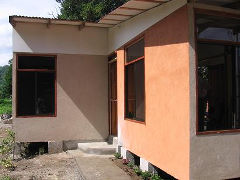
Home The Rodriguez family’s home
was constructed with the
assistance of Costa Rica’s
Habitat for Humanity.
|
|
|
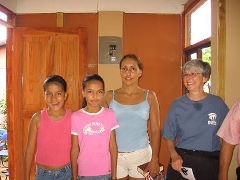
Family Karla Rodriguez Juarez
and her two daughters proudly
stand inside their new home,
located in the town of 27 de
Abril near Santa Cruz.
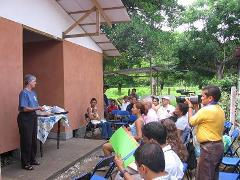
Inauguration A Habitat for
Humanity volunteer inaugurates
the Rodriguez’s new home, the
first to be constructed by the
organization in the Los Jobas
neighborhood.
|
|
|


