Panama:
Graffiti On Wheels
By Sara Miller
Llana
Panama City - Liriola Miranda, a
college statistics professor, steps aboard
Mr. Chiriqui, an old school bus blazing with
splashes of red and green that give homage
to the owner’s home province, Chiriqui, in
Panama.
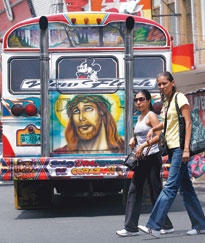
“The buses are an expression of identity,”
she says of Panama City’s main transport
system – a fleet of US hand-me-downs known
affectionately in Panama as “red devils,”
both for their hues and their hastiness as
they fly down the capital’s roads, honking
in search of passengers.
Sometimes the colorful expressions are
patriotic, other times it’s something
entirely different, Ms. Miranda explains,
shaking her head as another “red devil”
passes by, decorated with images of
bikini-clad women in both back windows.
The “red devils,” painted down to the
hubcaps, have turned Panama City’s streets
into a whirl of bright reds and oranges and
blues. Some are emblazoned with superheroes
and saints, pictures of Colombian singer
Shakira, or epic scenes of warriors fighting
off lions.
Bus décor is a mixture of romanticism and
manliness. Many are named after the owner’s
girlfriend or wife – but they are also
painted with macho slogans that shout
“force,” “power,” and “thunder” or
instructions like “If you don’t know the
rules, I’ll teach them to you.”
But now the transport system, which is both
ridiculed as anachronistic and celebrated
(like the privately owned taxis called
“tap-taps” that crowd Haiti’s capital,
Port-au-Prince) as a form of public urban
art, faces an uncertain fate.
The winner in Panama’s presidential election
early in May, supermarket tycoon and
right-leaning Ricardo Martinelli, made
modernizing the public transportation system
a main campaign pledge – calling for a
Panama City subway to alleviate the traffic
jams that have become chronic throughout the
capital.
Carlos Diaz, a bus driver for 18 years, says
he supports a new fleet of buses. “Let the
new ones come,” says Mr. Diaz, behind the
wheel of Mr. Chiriqui, his friend’s bus.
“We’ll paint the new ones!” he says,
smiling, before closing his doors and
driving off.
For Miranda, it’s a mixed bag. “On one hand
it is primitive. Panama is a city with
money, and we deserve a good public
transportation system,” she says, adding
that her cellphone was stolen from her on
her commute back from work recently.
Transportation consistently ranked as one of
voters’ top concerns, and helped knock out
the incumbent party. On the other hand, a
new fleet will replace one of the last
remaining idiosyncrasies of Panama City –
not unlike the way a chain store drives out
the local mom-and-pop shop.
“There is nowhere else in the world you can
find these [buses],” says Miranda wistfully,
but then perks up. “When they get rid of
them, I’ll try to buy one as a souvenir,”
she says. Or better yet, she brainstorms
later, she can transport one to her home
province and start a mini-tourist operation.
“That way their memory will live on.” |