Colombia's Cross-Border
Raid Repercussions
Likely To Linger
The Venezuelan Foreign
Ministry announced
Sunday the restoration
of diplomatic ties with
Colombia to follow
through their
reconciliation promise
at the Rio Group summit
that ended Friday in the
capital of the Dominican
Republic.
The move is seen as a
positive sign signaling
the easing of tensions
between Colombia and
Ecuador, Venezuela and
Nicaragua -- its three
neighboring countries
whose ties with Colombia
were badly affected by
the former's
cross-border attack on a
rebel base in Ecuador.
Unlike Venezuela which
was quick to patch up
relations with Colombia,
Ecuador said it is not
yet ready to
re-establish diplomatic
ties.
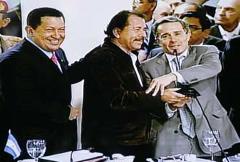
Analysts said the
seemingly friendly
handshakes between
presidents of the four
countries at the Rio
Group Summit that led to
the declared resolution
of their diplomatic
crisis is not likely to
put an end to the
deep-rooted tension
within the region.
On March 1, Colombia
trespassed Ecuadorian
territory in a
cross-border attack on
rebels of the
Revolutionary Armed
Forces of Colombia (FARC),
the largest rebel group
in Colombia, sparking
serious chain reactions
among its neighboring
countries.
Ecuador severed
diplomatic ties with
Colombia in protest of
the "territorial
violation."
Venezuela also withdrew
its embassy staff from
Bogotá and sent troops
to its border with
Colombia, offering ready
help to Ecuador whenever
necessary.
Nicaragua joined Ecuador
in cutting off ties with
Colombia, condemning the
cross-border attack as
"political terrorism."
Volatile confrontations
made many observers
believe the region was
on the verge of war.
However, the dismal
scenario took a dramatic
turn Friday when
Colombian President
Alvaro Uribe apologized
formally to Ecuador and
shook hands with his
Ecuadorian, Venezuelan
and Nicaraguan
counterparts at the Rio
Group summit at the
suggestion of Dominican
President Leonel
Fernandez and the
mediation of other
participating countries,
and resulted in a
publicly announced
peaceful resolution of
their diplomatic
tensions.
To many Latin American
leaders, the summit has
created favorable
conditions for the three
countries to end their
conflicts with Colombia
at an early date.
Despite the optimism
shown by Latin American
leaders at the summit,
analysts say the
regional tension
triggered by the
cross-border incursion
is expected to linger
much longer as conflicts
between these countries
are deep-rooted.
One of the disputes
centers on FARC.
Colombian President
Alvaro Uribe has taken a
tough stance against the
rebel group since he
took office in 2002,
labeling it as a
"terrorist
organization." Colombia
have accused Ecuador and
Venezuela of having
financial ties to FARC
and providing it with
safe havens.
Uribe said Tuesday that
Colombia plans to file a
case against Chavez in
the International Courts
of Justice for his
alleged financing of
FARC rebels, a charge
vehemently denied by
Venezuela.
Venezuela, which refuses
to regard FARC a
"terrorist
organization," showed
its significant
influence on the group
by securing the recent
release of six
high-profile hostages
held by FARC for more
than six years.
|
|