3G May Not Be A Reality
Until 2010
The dream of many in
Costa Rica to have a 3G
cellular telephone next
year may be dashed if
the Instituto
Costarricense de
Electricidad (ICE)
decides to opt for a new
bid process, refusing
the sole bid tendered by
the Chinese to install
the network by 2009.
Claudio Bermúdez,
manager of
telecommunications for
the state institution,
assured that the ICE
board of directors
considered not accepting
the bid by Huwai
Technologies on
Wednesday, days before a
letter a letter by Costa
Rican president, Oscar
Arias, suggesting the
same.
Huwai Technologies was
the only bidder left
after Noika, Siemens and
ZTE (Samsung) all backed
out of the bidding for
the new 3G network and
at a price of more than
double the estimate by
ICE. ICE officials
estimated the 3G network
would cost us$225
million, the Chinese
came in at us$538
million.
If the state telecom
decides to scrap the
Chinese bid and offer
the next generation of
cellular service up for
bid again, it would mean
a delay of at least six
months and delay the
introduction of the
service until 2010,
instea of mid 2009.
The process of tendering
a new bid would take at
least months, according
to a former directo fo
Área de Contratación
Administrativa de la
Contraloría General de
la República. The
president of the
Asociación Nacional de
Técnicos y Trabajadores
de la Energía y las
Telecomunicaciones (Anttec),
Jorge Arguedas, added
that it would up to six
months more to get the
network installed and
working before it can be
offered to the public.
ICE's executive
president, Pedro Pablo
Quirós, said that the
institution is seriously
analyzing the Chinese
proposal and that a
decision would be
forthcoming for at least
10 more days.
What all this means is
that some 550.000
current users of the
older technology TDMA
will have to hold on a
bit longer to switch
over to the latest
generation of cellular
service.
ICE plans to eliminate
entirely the TDMA
service, switching
customers to 3G, with
the ability to keep the
same phone number, if
they so choose. In
addition, thousands are
in line waiting to get
connected to any
cellular network, as the
country continues to
lack sufficient cellular
lines to meet the
growing demand.
Countries like El
Salvador and Honduras in
Central America already
are ahead of Costa Rica
in terms of the latest
cellular technology,
already offering 3G
service since last year.
What is 3G?
3G refers to the third
generation of
developments in wireless
technology, especially
mobile communications.
The third generation, as
its name suggests,
follows the first
generation (1G) and
second generation (2G)
in wireless
communications.
2G networks were built
mainly for voice data
and slow transmission.
Due to rapid changes in
user expectation, they
do not meet today's
wireless needs.
3G technologies enable
network operators to
offer users a wider
range of more advanced
services while achieving
greater network capacity
through improved
spectral efficiency.
Services include
wide-area wireless voice
telephony, video calls,
and broadband wireless
data, all in a mobile
environment.
3G technology gives fast
access to the Internet
and email over cellular
networks, allowing users
to surf the web,
download email, get
directions by GPS, and
watch video — even while
on a call.
Cellular mobile
telecommunications
networks are being
upgraded to use 3G
technologies from 1999
to 2010. Japan was the
first country to
introduce 3G nationally,
and in Japan the
transition to 3G was
largely completed in
2006. Korea then adopted
3G Networks soon after
and the transition was
made as early as 2004.
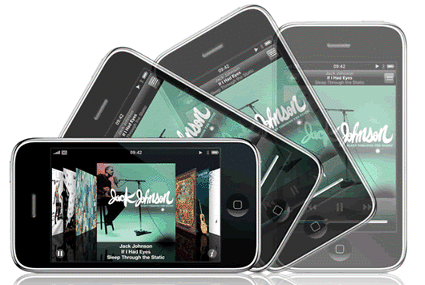
The Apple 3G iPhone is
considered the top of
five best cell phones by
CNet, followed by the
BlackBerry Curve 8320,
Nokia N95, Samsung
Instinct and Sony
Ericsson W760i.
|


