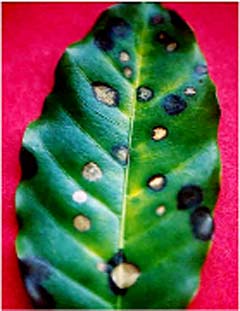
"Ojo de Gallo" Affecting
Coffee Production
More than half of the
coffee plantations
located at an altitude
of more than 1.400
metres (4.500 feet)
above sea level are
affected by a fungus
called "ojo de gallo",
Costa Rican officials
informed yesterday.
To avoid major damage to
crops, the del Instituto
de Investigación y
Transferencia de
Tecnología Agropecuaria
(INTA) is asking all
coffee growers to
immediately spray their
crops with a copper
based fungicides
Validamycin and
triazoles.
Validamycin is a
non-systemic antibiotic
with fungicide action.
It is most effective
against soil borne
diseases and is used for
the control of
Rhizoctonia solani in
rice, potatoes,
vegetables, and others
as well as damping off
diseases in vegetable
seedlings, cotton, sugar
beets, rice and other
plants. The U.S. EPA has
classified validamycin
as Toxicity Class IV-
practically non-toxic.
The INTA is also
recommending that growes
prune the plants, clean
the weeds and unshade
their plantations.
An "ojo de gallo" (eye
of the rooster) attacks
the leaves causing them
and the berries to fall
off the plant. Unchecked
it could potentially
destroy a large quantity
of crops and affect the
quality of coffee.
Ronald Peters of the
Instituto del Café (ICAFE)
has confirmed the Ojo de
Gallo and said that
Costa Rica the coffee
growing country taht is
most affected by the Ojo
de Gallo.
Peters added that the
presence of the Ojo de
Gallo will mean a lower
production than the
estimated 2.6 million
bushels it projected.
Costa Rica has seven
coffee plantation
regions, four of which
are above the 1.400
metres elevation that
includes the Tarrazú and
Tres Rios, two areas
that produce some of the
best coffee beans in
Costa Rica.
According to information
by the ministerio de
Comercio Exterior
(foreign trade
ministry), accumulated
sales to October are
us$230 million dollars,
10.7% higher that the
same period in 2006. |
|