|
Hostage Crisis At Russian Embassy
Shortly
after midday yesterday afternoon, a young man
took siege of the Russian embassy in San José,
holding eight hostages, including the Russian
ambassador, for more than fours hours before
surrendering, without incident, to police.
A few minutes after 12:30om, Román Bogdawynt, a
national from
a national from the former Soviet Union nation
of Kyrgyzstan, and who has been living in Costa
Rica since 2005, entering the country as a
refugee, took control of the embassy, using a
gun taken from the security guard on the scene,
held holding those inside the embassy hostage.
The man peacefully surrendered to police minutes
before 5:00pm, first demanding a ransom of
us$50.000 to deposited into his bank account
before releasing any of the hostages, and then
settled for a bottle of water and a cloak to
cover his face when escorted to a waiting police
vehicle.
Though there are conflicting reports, the
incident was over a settling of a debt which the
man had gone to the embassy to have resolved.
The first reports where that a gunman, fleeing a
nearby robbery scene had entered the Russian
embassy to hide out. That report was discarded
and news came that Bogdawynt was at the embassy
to renew his passport for his return home to
Kyrgyzstan.
However, word from the Russian ambassador,
Valery Dmitrievich Nikoláyenko, in a telephone
interview with a local television station, said
that the man had come to settle a financial
problem, a debt of some kind, and that no one
inside the embassy was in immediate danger.
Nikoláyenko said on national television that he
and two high ranking embassy officials were in a
separate, secure area of the embassy and though
he could leave, he chose not to until the
incident came to an end.
The question of was this a real hostage incident
began to rise, as there were no demands made,
save for the us$50.000 made less than an hour
before the gunman gave up and what seemed a last
minute attempt to prolong the situation, as
police negotiators continued to work to putting
an end to the standoff.
That hypothesis was furthered by the fact that
none of the hostages came out of the embassy
building after the gunmen surrendered, perhaps
due to the fact that embassy officials also live
in the residences area of the embassy.
Nikoláyenko said that he did not know the man
personally, but that his consul, who as at his
side during the incident, did and described the
man as non violent.
Bogdawynt's parents were called in to maintain
the young man calm and reports are that they
were a great influence in the non violent end to
the incident.
However, Costa Rican authorities were taking no
chances. With the aid of a Russian interpreter ,
they kept in constant touch with the young man,
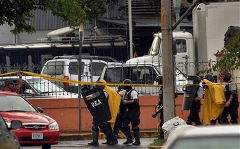
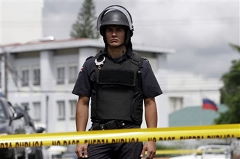
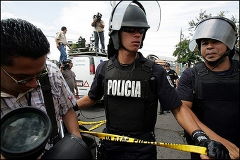
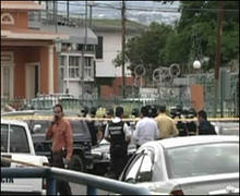
and closed off the area around the embassy for
blocks.
The situation complicated the police action
since this the embassy is a diplomatic centre
and Costa Rican authorities have no right to
storm the premises without the consent of the
Russian officials, nor do they have any official
authority once on the premises.
Agents of the Organismo de Investigación
Judicial (OIJ), controlled the situation, backed
by the Fuerza Pública. However, the final
movement was by the special unit, Unidad
Especial de Apoyo, under the direct command of
the Ministro de la Presidencia, Rodrigo Arias,
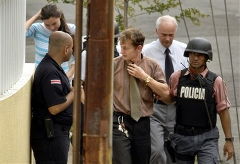
who went inside the building, handcuffed the man
and escorted him into a waiting OIJ vehicle.
The police action was without incident or
use of force. The man had indicated his
surrender and though it was believed he would
come out with his hands in the air, police moved
inside the building to handcuff him and take
him, with his face covered.
The case is now in the hands of the
Fiscales (prosecution lawyers) who will open a
case against the man for taking hostages.
However, judicial sources say that investigators
have hit a brick wall, as the Russian embassy
gave orders to its officials not to make any
statements.
In a statement to the press last night, Minister
Arias, dispalyed his satisfaction that the
incident was resolved without violence, injury
or loss of life and applauded the actions of the
police and their "crisis management" program
that was instituted following the hostage
incident at the Chilean embassy in July of 2004
that ended in a massacre.
|
|