|
|
 Polls Differ on
TLC Vote
Polls Differ on
TLC Vote
Arias To Ask China
For us$50 Million
Costa Rica signs UN
Convention on Migratory
Species
US Federal Officials
Ordered To Inspect
Imports From Costa Rica
Home Expo Starts Tomorrow |
|
US Federal Officials
Ordered To Inspect
Imports From Costa Rica
On orders from President
Bush, two top federal
regulators dropped in
Monday on marine
terminals in Camden and
Gloucester City to
observe how fresh
bananas and pineapples
from Costa Rica are
handled.
The Delaware River ports
are among a dozen stops
that Health and Human
Services Secretary Mike
Leavitt and Andrew von
Eschenbach, commissioner
of the Food and Drug
Administration, will
make within a two-week
tour to observe handling
practices that strive to
keep food bacteria free.
Leavitt's message Monday
was clear.
Food consumed in the
United States is safe,
but it could be safer.
And the job of
monitoring that process
will only get tougher as
the demand for imported
food is expected to
triple in the
not-too-distant future.
"Inspections are very
important, but we can't
inspect our way to
safety. The world has
become much more
complicated. We must
track all the way back
to the farm. We need to
know the type of
fertilizer used, when
product was harvested
and the health of people
handling it," said
Leavitt.
Despite recent outbreaks
of contaminated dog food
and antifreeze-spiked
toothpaste from China,
Leavitt and a special
committee appointed by
the president, are
evaluating practices in
all countries, not just
China.
"We are telling growers
around the world, if you
want to produce for
American consumers, you
need to meet our
expectations," he said.
FDA Commissioners von
Eschenbach, a urologist,
denied that the volume
of food-borne illnesses
has increased.
"The number of
occurrences is stable,
but our tracking is
getting much better due
to technology; so it
seems larger," said the
commissioner whose
agency regulates about
25 percent of the
American economy.
Part of the problem is
different standards for
different countries and
failure to communicate
those standards, said
Ross McKenney, vice
president of quality
assurance for Del Monte
Fresh Fruit.
Camden's Broadway
Terminal, which is owned
by the South Jersey Port
Corp., a quasi-state
agency, is Del Monte's
largest of five U.S.
ports.
"We pack for the highest
standard in the world
for every category,
rather than try to sort
product for different
buyers," he said.
Identifying the country
with the toughest
standards is difficult.
The United Kingdom, he
said, probably has the
highest standard for
ethical treatment of
workers, while Europe
has the least tolerance
for pesticide residue.
Forklift operator Abdul
Gunther said working the
Del Monte terminal is
one of the best jobs in
the ports of Camden and
Philadelphia. Del Monte
brings in about 120
ships per year.
"I'm very lucky. I have
a job every day and not
every longshoreman can
say that," he said.
Don Schaffner, a food
scientist with Rutgers
University, said
international food
safety is a relatively
new concern, so there is
still much to learn.
"As long as American
consumers demand
Guatemalan raspberries
and Chilean grapes in
winter, we're going to
have to hold other
countries' feet to the
fire and keep the
pressure up," he said.
Technology has also come
a long way in tracing
the cause of food-borne
illness.
"I don't think the
overall safety of food
has changed
significantly. If
anything, it might be
getting better. If two
people get sick in New
Jersey, four in Ohio and
one in New York we can
track the DNA of the
pathogen to determine if
its the same strain. If
so, it probably came
from the same source.
Then we can start to
nail it down by talking
to the people who got
sick." |
|
|
|
|
|
|
|
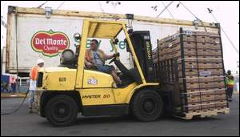
Longshoremen at the Del Monte facility
at Camden's Broadway Terminal, unload
pineapples from a ship. Federal
regulators saw how bananas and
pineapples from Costa Rica are handled. |
|
|
| |
|


