|
US$170 Million To Fix Roads
The
Banco Centroamericano de
Integración Económica (BCIE) has
agreed to hand over the Consejo Nacional de Vialidad
(CONAVI) us$170 million dollars
for the repair, reconstruction
and maintenance of the country's
road network.
The agreement was signed by the
BCIE and CONAVI at Casa
Presidencial yesterday.
Witness to the agreemetn was
Costa Rican president
Óscar Arias Sánchez,
Ministro de Hacienda (Revenue)
and Guillermo Zuñiga, that was
made official by the Ministra de
Obras Públicas y Transportes (MOPT),
Karla González and the BCIE
director for Costa Rica, Alfredo
Ortuño.
According to minister González,
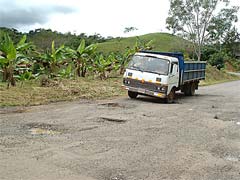
the money will go directly to
repair the roads that are in the
worst condition and to build
overpasses at some of the
rotondas (round abouts) in San
José. Without mentioning
specifics, the San Sebastián
rotonda is highest on the list
for an overpass, similar to the
one built at the Desamparados
rotonda.
The CONAVI made a formal request
to the BCIE last June and it was
approved within days. According
to BCIE director Ortuño, "the
poor condition of Costa Rica's
roads deserved priority".
Ortuño added that the BCIE
approval does not mean a debt
for Costa Rica, which it will be
able to recover the during the
next four years by its "impuesto
unico de los combustibles" -
gasoline tax - as stipulated in
Costa Rica's tax laws - Ley 8114
de Simplificación y Eficiencia
Tributaria de Costa Rica.
The BCIE is a leading source of
multilateral financing for the
integration and development of
Central America. Regional
members countries of the BCIE
are Guatemala, Honduras, El
Salvador, Nicaragua, Costa Rica.
Non-Regional members include
Argentina, Colombia, Mexico,
Republic of China and Spain.
Based in Tegucigalpa , Honduras,
BCIE was founded December 13,
1960 by Guatemala, El
Salvador , Honduras , Nicaragua
and Costa Rica to promote
regional integration and the
social and economic development
of the region.
On September 2, 1989 , in the
city of Managua , Nicaragua ,
the founding countries of BCIE
signed the Protocol of
Amendments to the Constitutive
Agreement, which allows the
participation of non-regional
countries as members of the
Bank. On January 1992, with the
deposit of the fifth
ratification instrument, the
modified Constitutive Agreement
came into effect, allowing the
direct incorporation of non
regional countries to the Bank’s
equity.
On November 1992, the Republics
of Mexico and China incorporated
as non regional members of the
Central American Bank, with a
contribution of us$122.5 million
and us$150.0 million,
respectively. Subsequently, in
March 1995 and April 1997, the
Republics of Argentina and
Colombia incorporated, in that
order, with a contribution of
us$57.6 million each. Spain
signed an adhesion agreement to
incorporate as non regional
member with a us$200 million
capital on March 5, 2004 .
|
|
|
|
|

Karla González, minister of
public works. |
|
|


