|
Nicaragua Threatened With Cutoff
of Dollars, U.S. officials Warn
Three more members of the U.S.
Congress are warning of dire
consequences if Daniel Ortega
wins the presidential election
in Nicaragua this Sunday.
With polls showing the
Sandinista leader within a
whisker of winning the 35
percent of the vote necessary,
four Republican House members
have suggested a cutoff of all
U.S. dollars to that country
should the "pro-terrorist"
friend of Iran and North Korea
succeed in the Nov. 5 election.
Rep. Dana Rohrabacher, R-Calif.,
chairman of the International
Relations Subcommittee on
Oversight and Investigation,
wrote to Michael Chertoff,
secretary of the Department of
Homeland Security, to call for
the U.S. government "to prepare
in accordance with U.S. law,
contingency plans to block any
further money remittances from
being sent to Nicaragua in the
event that the FSLN enters
government."
Joining Rohrabacher with
expressions of concerns are Rep.
Tom Tancredo, R-Colo., who wrote
to the Nicaraguan ambassador to
the U.S. warning about the
possible consequences of an
Ortega win, and Rep. Ed Royce,
R-Calif. and Rep. Peter
Hoekstra, chairman of the
Permanent Select Committee on
Intelligence, who wrote a
separate letter to Secretary of
State Condoleezza Rice.
All four are suggesting the
cutoff of "remittances" – cash
that flows from the U.S. to
Nicaragua through foreign
workers and companies to the
tune of $850 million a year.
Ortega, the leader of the FSLN,
holds a lead in the presidential
election among a number of
candidates, according to polls.
If the top vote-getter receives
35 percent of the total, he wins
the presidency. If he gets less,
he faces a runoff.
Two surveys gave the former
president and ally of the former
Soviet Union and Fidel Castro –
along with Iran and North Korea
– 34.4 percent and 33.8 percent
support, a whisker short of the
35 percent needed to secure the
presidency in the first round.
This is Ortega's third comeback
attempt after being voted out in
1990. Besides his alliances with
Castro, Iran and North Korea, he
is also friendly with
Venezuela's anti-U.S. firebrand
Hugo Chavez.
Polls have consistently tipped
Ortega to come in first, but his
lead is due to a split among a
group of pro-U.S. leaders, and
he could easily lose a run-off
against either close rival.
When Ortega was last in power,
President Reagan denounced his
regime as "one of the world's
principal refuges for
terrorists" and a "partner of
Iran, Libya, North Korea and
Cuba in a campaign of
international terror."
"Nicaraguan passports were
issued to international
terrorists to facilitate their
movement across borders," said
Rohrabacher. "In 1993, it was
reported in the Washington Post
and elsewhere that one of the
terrorist suspects arrested by
the FBI for the first World
Trade Center bombing carried
five authentic, but fraudulent,
Nicaraguan passports, apparently
issued by officials in that
country."
Rohrabacher fears a return to
that kind of insurgency against
the U.S. in the western
hemisphere should Ortega and the
Sandinistas sneak back into
power. He wants to stop the flow
of U.S. dollars – about $700
million of which come into that
country through routine
commerce.
Not only do Ortega and the
Sandinistas have long-standing
friendships with Iran, North
Korea and Cuba, but many of them
also were trained in the Middle
East with the Palestinian
Liberation Organization under
the sponsorship of Yasser
Arafat.
Recently, both Daniel Ortega and
his brother, Humberto, paid
official state visits to North
Korea seeking assistance and
formal relations. Also,
recently, the prime minister of
Iran visited Nicaragua,
expressing "solidarity from the
ayatollah for the Sandinista
communists."
A victory by Ortega would spell
a major turnaround in
U.S.-Nicaragua relations,
because the current government
is very cooperative with
Washington.
|
|
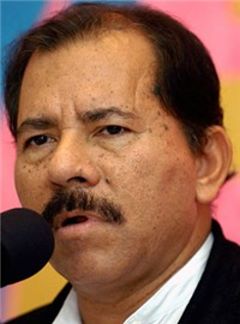
Daniel Ortega |
|
|
|
|
|


