|
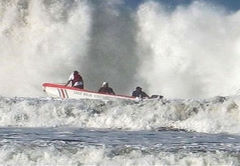
Puerto Viejo Doesn't Want
Drownings On Its Beaches
Although most of the beaches in
Costa Rica - especially the more
dangerous ones - do not have
life guards or any signs, Playa
Cocles, in Puerto Viejo (Limón)
is changing that.
The beach, located in the south
Caribbean coast has strong
currents, huge waves and has in
the last several years become a
favourite tourist spot and the
project "Salvavidas playa Cocles"
that began in 2003 put an end to
tragedies like the one that saw
five tourists lose their lives
in March of 2002.
Many tourists are asking why the
beaches don't have signs and
possibly avoid tragedies like
the one suffered last in Palo
Seco, Parrita, on the Pacific
coast. The answer is simple, it
costs money and the government
doesn't make it a priority.
That is why in Cocles, the
Salvavidas project is financed
by 60 local merchants, who each
month contribute from their own
pockets or from customer
donations, some ¢500.000 colones
(us$1.000) per month to pay the
salaries of two lifeguards that
on watch every day, according to
Eddie Ryan, vice-president of
the Cámara de Turismo de Puerto
Viejo.
"It is a good formula. Since the
beginning of the program there
have been no drownings at Cocles",
said Ryan.
Ryan sais that Cocles is a pilot
project that he hopes will be
adopted by many beach
communities around the country.
The tourism chamber
vice-president says that the
lifeguards are paid ¢9.000
colones (us$17.50) daily, plus
insurance and medical benefits.
During Semana Santa and other
holidays where the number of
tourists increase, one
additional lifeguard is added to
the post.
The lifeguards, not only get
paid but also have the basic
lifesaving tools available to do
their job.
"The government is too busy with
other things than to implement a
project like this one in the
country, so beach communities
should adopt their own
lifesaving programs", said local
merchant Bruno López.
Jorge Rovira, sub-director of
operations of the Cruz Roja
Costarricense (Costa Rican Red
Cross) again last week made an
urgent call on the necessity of
life guards and signage at all
the beaches in the country.
According to Cruz Roja records,
this year alone there have
already been 25 deaths from
drowning at various beaches in
the country.
A letter from Jessica's Aunt
Could someone please explain to
me why there wasn't warning
signs posted on the beach at
Palo Seco warning tourists about
the current.
I understand that it is a
popular area with tourists, but
before last week's drowning of 3
Kansas students and their
teacher at least 4 other people
have lost their lived in
drowning accidents this year
alone along that area.
I for one am outraged.
It seems to me that the last of
postings is saying that by
warning to the general public of
the currents you could love
potential tourists to the area.
Does money mean that much to
your country?
A couple of kids said that they
were told that it was OK to swim
as long as they were careful. I
for one do not feel this
adequate.
Money can be replaced, BUT LIVES
NOT. Before this happens again
to someone else's family, I
would hope somone would do
something to rectify this.
Danielle, Andrew, Jessica and
Brett was someone's child,
brother, sistet, etc. Think how
you would feel if the show was
on the other foot.
Sandrah Pierce (Jessica's Aunt).
|
|