|
Holiday Monday?
Today, Monday, July 31, is a
holiday. Many are not sure what
holiday it is and why it is
being celebrated. The majority
of Guanacastecos celebrated
their holiday last Tuesday, July
25, the day of the Anexión de
Nicoya, when it became part of
Costa Rica.
The residents of Guanacaste
don't like the idea of the
"legal" holiday moved to the
following Monday and as such
have asked president Oscar Arias
to rescind the presidential
decree signed by former
president Abel Pacheco. Arias
agreed to the change.
For those living outside of
Guanacaste, they accept the day
off work but don't really
understand what the fuss is all
about.
This year the holiday coincides
with the annual "romerias" -
pilgrimage - to Cartago, where
the devout walk to Basilica de
Los Angeles in Cartago to pay
homage to the Virgen de Los
Angeles or La Negrita as she is
commonly referred to.
Since Friday, the faithful have
been making their way to Cartago,
beating the rush that is
expected tomorrow or coming from
as far away places like San
Ramón and Perez Zeledon. Some
have even come from as far away
as Puntarenas, like Martha Pérez,
who left Friday and is expected
to make it on her knees on
Tuesday. The tradition is to
make the last few metres from
the entrance of the Basilica to
the altar where the statue of
the La Negrita is located, on
the knees.
The annual walk is not only for
Costa Ricans, but also for many
foreigners living here or just
visiting.
The largest number of visitors
to the Basilica are expected on
Tuesday night. Many "romeros"
leave in the early evening of
Tuesday, after work and taking
advantage of the coolness of the
night, to gather for their
offerings to La Negrita in the
early hours of Wednesday
morning.
Though Wednesday is classed as
holiday, it is not an "official"
holiday. Some private business
will be closed Tuesday and
Wednesday.
Employers can voluntarily give
the day off with or without pay.
The Minister of Labour clarified
the confusion as many workers,
accustomed to a day off on
August 2, were reminded that it
is not a paid holiday and can
expect their employers to reduce
their pay if they decide to skip
work.
The Policía de Tránsito (traffic
police) are out in full force
along the route from San José to
Cartago, as well the Cruz Roja
(Red Cross) have set up 12
permanent as a number of mobile
posts along the route to ensure
safety and offer first aid to
those in need. The Fuerza
Pública is also out there
ensuring public security.
|
|
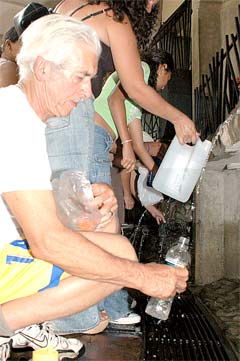
As
part of the tradition of the "romeria"
to Cartago is the filling the
bottles of water that is said to
be "blessed" and to possess
healing powers. |
|
|
|
|
|
|


