|
Strong Quake Jolts
Vacationers, No Injuries Or
Damage Reported
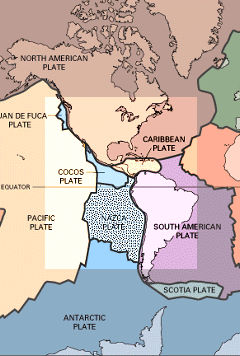
It was 9:28am when a collision,
called subduction, between
theCocos and Caribe tectonic
plates produced a quake
registering 5.1 on the Richter
scale, that was felt throughout
the country.
The epicentre was located in the
area of Los Santos (Fila la
Candelaria), about 30 kilometres
northeast of Quepos.
This was the strongest
earthquake this year in Costa
Rica. There were no reported
damage or injury, just a big
scare, as the movement was short
but violent. The other major
jolts this year were not centred
in Costa Rica.
Experts say the activity is
normal. According to Marino
Protti of the Observatorio
Sismológico y Vulcanológico de
Costa Rica (Ovsicori), this
earthquake was not a shock
between the oceanic tectonic
plates but rather continental.
The last "big" earthquake
was on November 21 last
year when
a quake registering 6.2
on the Richter scale with the epicenter was located about
10km northeast of Quepos with a
depth of about 30km and felt as
far away as Cartago, leaving
eight dead and more than 500
homes damaged.
A 6.0 earthquake
was felt on December 25, 2003 in
Puerto Armuelles
and a 5.7 in Alajuela occurred
on December 22, 1990.
MAJOR TECTONIC PLATES OF THE
WORLD
The earth's surface is
broken into seven large and many
small moving plates. These
plates, each about 50 miles
thick, move relative to one
another an average of a few
inches a year. Three types of
movement are recognized at the
boundaries between plates:
convergent, divergent and
transform-fault.
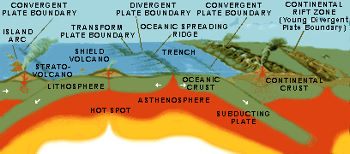
At convergent boundaries, plates
move toward each other and
collide. Where an oceanic plate
collides with a continental
plate, the oceanic plate tips
down and slides beneath the
continental plate forming a deep
ocean trench (long, narrow, deep
basin.) An example of this type
of movement, called subduction,
occurs at the boundary between
the oceanic Nazca Plate and the
continental South American
Plate. Where continental plates
collide, they form major
mountain systems such as the
Himalayas.
At divergent boundaries, plates
move away from each other such
as at the Mid-Atlantic Ridge.
Where plates diverge, hot,
molten rock rises and cools
adding new material to the edges
of the oceanic plates. This
process is known as sea-floor
spreading.
At transform-fault boundaries,
plates move horizontally past
each other. The San Andreas
Fault zone is an example of this
type of boundary where the
Pacific Plate on which Los
Angeles sits is moving slowly
northwestward relative to the
North American Plate on which
San Francisco sits.
Plate tectonics, the branch of
science that deals with the
process by which rigid plates
are moved across hot molten
material, has helped to explain
much in global-scale geology
including the formation of
mountains, and the distribution
of earthquakes and volcanoes.
|
|