|
Tico Killed By Marshals on Miami
Flight
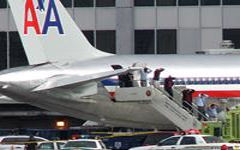
Rigoberto Alpizar bolted down
the aisle of American Airlines
Flight 924 shortly after 2 p.m.
Wednesday in Miami International
airport.
In pursuit behind him, through
the narrow passageway of the
Boeing 757: his female companion
- police believe it was his wife
- yelling ''stop, stop'' in
English and then in Spanish,
``He's sick, he's sick.''
The chaos ended quickly. Federal
agents shot Alpizar, 44, a
U.S. citizen, originally from
Costa Rica, died on the scene.
He had arrived in Miami from
Quito, Ecuador, earlier
Wednesday and was headed back to
Orlando.
Police say the man claimed he
had a bomb in his backpack.
The incident drew nationwide
media attention and marked the
first time a passenger was
gunned down by undercover air
marshals since marshals became a
fixture aboard many U.S. flights
in the wake of the Sept. 11,
2001, terrorist attacks.
Passengers said they recalled
Alpizar acting erratically
earlier, during the boarding
process for the Orlando-bound
flight.
''He didn't look stable,'' said
John McAlhany, a Sebastian
construction worker in seat
24-C.
Alpizar dashed to the front of
the plane, knocking down flight
attendants and startling
passengers ready for takeoff.
Passengers said Alpizar's
companion returned to her seat
to retrieve their luggage. But
before she could return, Alpizar
was already being confronted by
two federal air marshals.
Alpizar, clutching his backpack,
did the wrong thing. He
''uttered a sentence to the
effect that he had a bomb'' in
his backpack, said Jim Bauer,
Special Agent in Charge of the
Federal Air Marshals service in
Miami.
The marshals ordered him to the
ground. But Alpizar didn't
comply.
Alpizar reached into his bag
instead. And in that split
second, the armed marshals made
their decision. They opened
fire.
''The threat escalated,'' Bauer
explained. ``He was in the
vicinity of the front door when
he was shot.''
According to Department of
Homeland Security officials,
there was no evidence the
incident was related to
terrorism.
''There's no reason to believe
right now that there is any
nexus to terrorism, or that
indeed any other events are
associated with this one,''
Bauer said.
Still, law enforcement officers
checked other airports around
the country and found no
evidence of any other attacks
being coordinated, Bauer said.
The shooting occurred within
earshot of other horrified
passengers, who reported hearing
at least five shots fired. It
was unclear if both air marshals
- who were not identified -
fired their weapons.
Alpizar's His family, in the
United States and Costa Rica,
were stunned at the news.
Alpizar, who worked in the paint
department of a home improvement
store, had been flying through
Miami after a working vacation
in Peru, said his
brother-in-law, Steven Buechner.
He said Alpizar met his sister,
Anne, when she was an exchange
student in Costa Rica. They had
been married about 22 years,
relatives said.
''Our family is still in
shock,'' said Kelley Buechner,
Alpizar's sister-in-law, by
telephone from Milwaukee.
His neighbors in suburban
Orlando, where he lived on an
oak-lined, middle-class street,
told The Associated Press they
had noticed nothing wrong.
''He was a nice guy, always
smiling, always talkative,''
said Louis Gunther, 73, a
neighbor who said he was
watching Alpizar's home while he
and his wife were on a church
trip. ``Everybody is talking
about a guy I know nothing
about.''
After the shooting, law
enforcement officers surrounded
the plane. Inside, McAlhany said
passengers were ordered to
crouch under their seats. He
said when he tried to pop up for
a look, a flight attendant
ordered him to get back down.
He said the man apparently left
a backpack on the plane, adding
that the other passengers were
treated roughly when law
enforcement boarded the plane
after the shooting.
'They put a gun to the back of
my head and said, `Put your
hands on the seat,' '' he said.
``That was more scary than
anything else.''
He said the passengers were
taken off the plane and confined
to a conference room ``with a
lot of other people.''
Although law enforcement
officers blew up two pieces of
luggage apparently belonging to
the suspect, officials said no
bomb or weapon was found on the
plane or passenger.
''I don't know if they shot an
innocent man or not,'' McAlhany
said. ``I don't think he was
armed or had a bomb. I think he
had a mental illness. I don't
think they really had to shoot
him, but I hope he didn't holler
something stupid.''
The plane had arrived from
Medellin, Colombia, and was
headed to Orlando at 2:18 p.m.
but the Orlando-bound leg,
American Flight 924, was
subsequently canceled, according
to the Orlando airport's
website.
American Airlines officials did
not say how the 113 displaced
passengers would get to Orlando.
''None of the other 113
passengers on board were
affected or were ever in any
danger. This was an isolated
incident,'' the airline said in
a press release, adding that it
would have no other comment.
American Airlines chief
operating officer Gerard Arpey,
who was at The Herald meeting
executives when the shooting
occurred, declined to comment.
The airport was never closed.
Concourse D, where the incident
took place, was shut down for
about 30 minutes, said Miami
airport spokesman Marc
Henderson. Air traffic continued
as usual by mid-afternoon.
Police spread the passengers'
bags that were to be loaded on
American 942 on the tarmac and
had dogs sniff them for
explosives. The investigation --
by Miami-Dade police homicide
detectives and federal officials
-- continued Wednesday night.
Herald reporters Cara Buckley,
Theresa Bradley, Frank Davies,
Rebecca Dellagloria, Tere
Figueras Negrete, Steve
Harrison, Phil Long, David
Ovalle and Jay Weaver and The
Associated Press contributed to
this report.
|
|