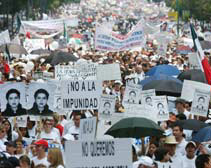
Huge
march against crime wave in Mexico
At least a quarter of a million Mexicans
marched through the capital and other cities on Sunday to protest
authorities' failure to control lawlessness in one of the world's most
crime-ridden countries.
In the biggest demonstration in Mexico in more than 10 years, protesters
dressed in white filled Mexico City's main Zocalo Square, which holds
more than 100,000 people, and packed surrounding avenues, according to
Monday's China Daily.
Many carried banners urging the death penalty for
kidnappers, rapists and murderers.
Even crime-hardened Mexicans have been shocked by a recent wave of
kidnappings. In one case last month, two brothers were abducted, shot
dead and their bodies dumped in a garbage bin even though their parents
paid a $600,000 ransom.
The bells of the city's cathedral rang out to greet marchers who sang
Mexico's nation anthem in the square.
In Tijuana, near the U.S. border, 15,000 people marched through to
protest crime, and smaller protests took place in other Mexican cities,
local media said.
Mexico United Against Crime, one of the march organizers, said anywhere
between 350,000 and two million people took part in the protest. Local
media put attendance at more than 250,000.
From 1992 to 2002, Mexicans reported at least 15,000 kidnappings, second
only to war-torn Colombia, according to the Inter-American Development
Bank.
March organizers said most violent crime goes unreported, partly because
of police corruption and a sense that nothing will be done.
"We are afraid. We can't go out onto the street and the police do
absolutely nothing to protect us," said Yolanda Tellez, 62, who is
retired.
A group of businessmen hired New York's crime-busting former mayor
Rudolph Giuliani last year for $4.3 million to help clean up Mexico City
and police say tough new "zero tolerance" measures in the capital are
working.
But kidnapping and assaults are still common and federal police last
week arrested a group of elite policemen in Mexico City who abducted
businessmen using false arrest warrants.
The march has pitted President Vicente Fox against political rival
Andres Manuel Lopez Obrador, the mayor of Mexico City, who protesters
accuse of being too soft on violent crime.
Conservative Fox said last week he was waging "the mother of all battles
against crime" and urged Mexico City's leftist administration to do
more.
But protesters were unimpressed by both Fox and city hall.
"They have politicized the issue so much instead of doing something
about crime," said Victor Manuel Rojas, riding a horse and carrying a
flag with Mexico's patron saint, the Virgin of Guadalupe.
The event was billed as silent but protesters broke into chants of
"Mexico, Mexico."
The murder of a crusading journalist in Tijuana this week was a reminder
that drug gangs flourish on the U.S.-Mexican border despite a crackdown
by Fox's government.
Police have also failed to make headway in solving the murders of more
than 300 women in the last 10 years in the city of Ciudad Juarez, near
the border with the United States. Amnesty International has accused
police in the city of gross negligence in failing to end the killings.
In Mexico City, marchers carried photographs of murder victims.
"She was my cousin," said protester Eduardo Torres, clutching a framed
picture of a young girl in a party dress. "They kidnapped her and killed
her two months ago."
Major drug
cartel broken up: Colombian police
The Colombian police broke up a key
international drug ring Sunday, arresting 81 drug traffickers and
confiscating 3.5 tons of cocaine and 2 million US dollars.
Based on the information provided by the US Drug Enforcement Agency (DEA),
the Colombian police destroyed the cartel after six-month tracking,
Colombian National Police Force General Chief Jorge Daniel Castro said.
Castro said that in the two raids in Bogota and Bucaramanga, the
Colombian police arrested 81 people while the US police arrested six
members of the cartel in Miami.
According to preliminary investigations, the cocaine group has smuggled
cocaine from Colombia to the black markets in Miami, Orlando and New
York in the United States through Jamaica and Bahamas in the past five
years. It sends 94 tons of cocaine to the United States every year.
Colombia is the world's top cocaine producer, turning out 580 tons of
cocaine a year and accounting for 90 percent of the global production.
According to official figures, the Colombian army and police have
arrested more than 400 drug traffickers and seized 70 tons of cocaine
since the beginning of this year.
Former Haitian prime minister arrested
Haiti's former prime minister Yvon Neptune was
arrested Sunday after a five-month hiding, news from Port-au-Prince
reaching here reported.
Neptune had been in hiding after President Jean-Bertrand Aristide was
forced into exile in February. He surrendered to police Sunday and was
taken to the National Penitentiary in the capital.
A judge in Saint Marc issued an arrest warrant for Neptune on the charge
of mass murder in mid-February in Saint Marc, 95 kilometers north of
Port-au-Prince. Fifty people were reportedly killed in the attacks.
|