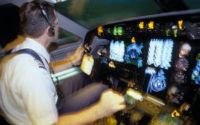
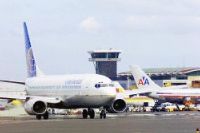
Air Traffic
Normal at Airports
Air traffic controllers who have been on
strike since Saturday morning say that they fear for the safety of air
passengers now that the controls tower at Costa Rica's airports is in
the hands of foreigners and Tico pilots.
Transport Minister Javier Chaves says that the strike
has not had the impact controllers had hoped and that all the airports
are operating normally.
However, the Daniel Oduber airport in Liberia was closed on Saturday
until 4pm and the Tobías Bolaños (Pavas) and Juan Santamaria (San José)
airports experienced many delays Saturday morning.
The controllers decided to walk off the job after negotiations with the
government were not going anywhere and learned that the government had
brought in 20 foreign air traffic controllers in the even that there was
a strike.
The Transport Ministry brought in controllers from Nicaragua, Honduras,
Perú and El Salvador. The first group, all 20 of them, arrive on Friday,
while the remaining 8 arrived yesterday.
Chaves said that all the foreign controllers are properly trained and
have the necessary work permits to work in Costa Rica and are being paid
$150 each per day.
Marco Badilla, Director of Immigration, said that the government has the
right to issue work permits to foreigners in such emergencies as
they exist at the airports. The immigration director told the press that
he signed their work permits on Friday.
Transport Minister Chaves said that all flights on Sunday left and
arrived on schedule and that the airports are functioning normally.
Leonardo Guillén, spokesperson for the air traffic
controllers said he waiting on the government to call the union back to
the bargaining table so that they can end the dispute and bring safety
back to the air.
Meanwhile, Transport Minister Chaves, indicated on Sunday that he will
be seeking a court order on Monday (today) to force the controllers back
to work.
The strike is not about a salary
increase. The controllers want that the government keeps to it's
agreement of
1994 where air traffic controllers would earn 35% more in salaries than
that of civil aviation inspectors.
Thirty Six
Foreigners Detained in Six Days
Immigration police report that a total of 36 foreigners have been
detained in the last six days, confirming that the Costa Rica is being
used a bridge point for the illegal traffic of persons to the United
States.
According to immigration officials, 16 of the detained are from South
America, 8 were Chinese and 6 Cubans. In the case of the Chinese,
officials uncovered a new route that was being used by "coyotes", moving
people from one country to another with the final destination being the
U.S.
Marco Badilla, Immigration Director, told the press at a conference that
the orietnals left China and are believed to have traveled to Malasya,
Egypt, Russia, Colombia, Panama and Costa Rica before moving on to the
U.S.
The eight Chinese had valid passports issued in Taiwan, however, the
photos had been altered.
Three Taiwanese nationals were also detained by police, who are
suspected of being the "coyotes" who were leading the group of Chinese.
The three men were released shortly after because Costa Rica does not
have the necessary laws to punish the crime of trafficking of persons.
Police, both Immigration and Fuerza Publica officers, are vigilant of
foreigners in the streets and have been spotted questioning foreigners
to verify their legal status in Costa Rica.
In
Transit? MIA Moves to Move You Along
For months, Miami International Airport must
have seemed like a labyrinth to passengers traveling from one foreign
destination to another.
Upon arrival, they would withstand long lines at immigration, then trek
to the main terminal, just to turn around, get screened and find their
way back to their gates -- often ending up exactly where they had
started.
Travel time through MIA: as much as 2 ½ hours.
In August 2003, the federal government suspended its
International-to-International and Transit Without Visa programs, saying
it had credible evidence that terrorists would try to take advantage of
loopholes to gain access to the United States or to aircraft.
The change hit MIA hard. Nearly a million international-to-international
passengers transit through the airport each year, said Dickie Davis,
manager of terminal operations for Miami-Dade Aviation.
Passengers were required to go through the time-consuming procedure,
which, for Iberia and Martinair, involved taking a commuter train twice.
It led to flight delays, missed connections and frazzled nerves -- and
possibly to a loss of future bookings from disgruntled passengers --
airport and airline executives said.
Martinair, which connects passengers from Amsterdam to San José, Costa
Rica, often had to pay for hotel stays for travelers and received dozens
of complaints, said Xiomara Winklaar, station manager for Martinair in
Miami.
Now, the issue resolved, the airline expects to expand from nine to 14
flights a week, to Amsterdam and San José, beginning Oct. 31.
''It's only because of this,'' Winklaar said. ``If not, it would never
have been approved.''
But now thousands of in-transit passengers on American Airlines, Iberia
Airlines and Martinair are benefiting from an expedited process. The
change allows passengers to go through immigration, enter an in-transit
lounge with its own checkpoint, then go back to their gates -- cutting
hours off the process.
Only MIA -- which has more in-transit travelers than any other U.S.
airport -- has the new procedures.
''It's much more comfortable,'' said Angela Gittens, director of the
Miami-Dade Aviation Department. ``They can eat, buy things. It's much
more of a pleasant passenger experience.''
One immediately noted change is that new checkpoints have opened. The
first was at a distant satellite location to Concourse E, which serves
Iberia and Martinair; the latest opened last week at Concourse D,
serving American. Other carriers also may use the checkpoint for
in-transit passengers.
 News
Briefs News
Briefs
-
The devaluation of the Colon has
slowed down in the first five
months of this year. The rate is
expected to be about 10% for
this year, down from then 16%
during the year 2003.
|