Costa Rica Attorney General
Urges Court to Reject Support
for Iraq War
A coalition of the unwilling is
growing in Costa Rica. Attorney
General Farid Beirute has urged
the country's top court,
Constitutional Court, to
formally reject Costa Rica's
membership in the
U.S.-proclaimed coalition of
support for the war in Iraq.
Beirute
and Deputy Attorney General Ivan
Vicente told the court on
Thursday that a declaration of
support for the U.S. war would
violate at least two elements of
Costa Rica's constitution.
Vicente said the constitution
bars support for military action
that is not authorized by the
United Nations and said the
statement violates the pacifist
constitutional principles of a
country that has no formal armed
forces.
Controversy over the issue
erupted when the Spanish daily
newspaper, La Nación, noted that
the U.S. White House had listed
Costa Rica as a member of the
coalition "that has already
begun military operations to
disarm Iraq of its weapons of
mass destruction."
President Abel Pacheco and
Foreign Minister Roberto Tovar
acknowledged signing a statement
of support for the United States
on March 19, 2003, but they
insisted it was support merely
for the fight against terrorism
-- not for an invasion of Iraq,
as the U.S. statement implied.
"In the conflict between peace
and terrorism, we are not
neutral," read the statement
they signed. "Costa Rica is and
will be a loyal, firm, and
resolute ally in favor of those
who look for peace, freedom,
democracy, and respect for
international law."
Pacheco's action was widely
criticized and the
Constitutional Court received
three formal petitions from
individuals and institutions to
declare it unconstitutional.
The court has an additional
month in which to rule.
While the attorney general's
office is legally in charge of
defending the state, it can
interpret that duty broadly. The
attorney general is chosen by
the country's congress rather
than by the president.
In a news release Thursday,
Tovar defended the document he
had signed last year, saying
that revoking the statement
"would gravely injure the
foreign policy positions of the
Costa Rican state."
Minors Demand Better Conditions
at PANI
Minors under the
protection of the child welfare
agency, Patronato Nacional de la
Infancia (PANI) are demanding
better living conditions at it's
shelters.
Some children has resorted to
screams to make their point,
while destroying several
matresses and breaking windows
at the Montes de Oca shelter.
The children are protesting poor
living conditions at the centre
and lack of attention by
professionals.
According to PANI chief,
Minister Rosalia Gil, she says
the behaviour is a result of
drug addiction, resulting in
violent behaviour by some of the
children.
Two of the children who started
what could almost be called a
riot will receive psychiatric
treatment.
Mother's Day Tomorrow
Tomorrow is Mother's
Day in Costa Rica, a holiday
that is celebrated in several
nations around the world on the
second Sunday in May. In Costa
Rica it is always celebrated on
the 15th of August.
A stroll on the Avenida Central
(the Boulevard) saw an increase
of pedestrian traffic during
this week, along with an
increased police presence to
ensure safety as shoppers with
cash in their pockets look for
that perfect gift for mother. At
the malls and shopping centres
the situation was the same.
And because this year Mother's
Day falls of a Sunday most
employers made their payroll
Friday, allowing their employees
the benefit of Saturday
shopping, which will mean more
that usual traffic and
congestion on the streets and in
the malls.
Many are taking advantage of the
weekend holiday to leave the
city and head off to the beaches
or farms, congesting even more
the busy highways.
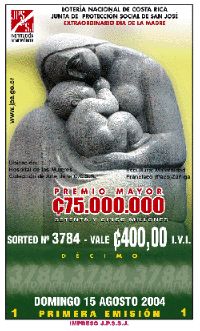
Even the lottery has a special
Mother's Day edition with a
first prize "premio mayor" of
¢75.000.000 colones, almost
double the normal for the weekly
Sunday draw.
Historians claim that this day
emerged from the custom of
mother worship in ancient
Greece. Mother worship which
kept a festival to Cybele, a
great mother of gods, and Rhea,
the wife of Cronus, was held on
March 15 to March 18 around Asia
Minor. They insist that this
custom spread around the world.
Mother's Day in the United
States was first proclaimed in
1870 in Boston by Julia Ward
Howe's Mother's Day
Proclamation, and Howe called
for it to be observed each year
nationally in 1872. The
first known observance of
Mother's Day in the U.S.
occurred in Albion, Michigan on
May 13, 1877, the second Sunday
of the month.
In 1907 Mother's Day was first
celebrated in a small private
way by Anna Jarvis in Grafton,
West Virginia, to commemorate
the anniversary of her mother's
death two years earlier on May
9, 1905. Jarvis's mother, also
named Anna Jarvis, had been
active in Mother's Day campaigns
for peace and worker's safety
and health. The younger Jarvis
launched a quest to get wider
recognition of Mother's Day.
A tradition calls for the
wearing of carnations on
Mother's Day - a red one if
one's mother is alive, and white
if she has died.
It is not clear when Mother's
Day made it's first appearance
in Costa Rica and how the
tradition got started here.
However, the holiday represents
the second largest shopping
event of the year for retailers,
second to Christmas.
La Fuerza Publica, under the
command of Walter Navarro, has
been ordered to provide greater
security on the principal
streets of San José, especially
the points with higher incidents
of street crimes. The order has
also gone out to smaller towns.
Ticos Will be Asked to Reduce
Gasoline Consumption
A plan to reduce the
use of gasoline in Costa Rica or
to at least make drivers aware
of the high cost due to rising
world crude oil prices, will be
tabled on Tuesday, as government
officials discuss the various
options available.
Ricardo Toledo, Minister for the
Presidency, said that the
government has to take "strong
measures" as the gasoline
situation is grave. "Costa
Ricans must know that every time
the cost of a barrel of oil
rises of $40, the Central Bank
reserves are eaten up", Toledo
said.
Last year the final bill for the
purchase of crude was US$500
million dollars, this year it is
expected to pass the US$600
million mark. The government has
been worried on the affect this
will have on the overall economy
and needs to take measures,
asking Costa Ricans to
collaborate in consuming less
fuel.
Part of the government's plan is
to launch a media campaign to
let Costa Ricans know the
seriousness of the problem.
Some ideas being tabled on
Tuesday will include:
- the used of electrical
vehicles
- regulate gasoline station
hours
- regulate public employee hours
to reduce traffic jams
- restrict vehicular circulation
to even and odd days depending
on the last number of the
license plate
- reduce "official" vehicle use
and use the post office vehicles
to deliver official mail
The government also plans to
appoint a commission to study
the various proposals and make
recommendations. The commission
will be made up of: Litleton
Bolton, president of Recope (the
national refinery); Pablo Cob,
president of ICE (the
telecommunications giant);
Javier Chávez Bolaños, Minister
of Transport and Public Works (MOPT);
Carlos Manuel Rodríguez, chief
of Minae, Ricardo Toledo;
Ignacio Sánchez, director of
Transit; and Fernando Gutiérrez,
ministrer of Science and
Technology.
Non-stop Flights to Madrid
The Spanish airline Iberia will fly
four times a week non-stop from Costa Rica to Madrid.
The flights - lasting 11 hours in each direction - are to start next October
2 and, according to Iberia's site on the internet, each round-trip ticket
would cost $699.
The flights to Madrid will be scheduled Tuesdays, Thursdays, Saturdays, and
Sundays, but airline spokespeople said that the remaining three days of the
week there will be flights from Madrid with a stopover in Guatemala.
According to Minister of Tourism Rodrigo Castro, the non-stop route means
that the number of European tourists coming to Costa Rica this year will
increase some 30 percent to some 187,000 visitors.
Canada Donated $406,000
As part of the cooperation program
between Costa Rica and Canada within the Free Trade Agreement between the
two nations, the Canadian Government donated $406,000 for a labor
administration program.
The funds are to be used on the second phase of the "Strengthening of Labor
Administration" project, which includes the training of labor inspectors on
topics such as the prevention of accidents and the solving of conflicts.
Canada had made a prior donation of $436,000 for the first stage of the
project.
|