Colombia's Uribe denies drugs
cartel links
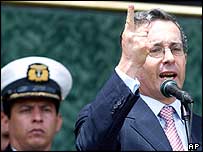
Colombia's government
has denied media reports
alleging that President Alvaro
Uribe collaborated with a
powerful drug cartel more than a
decade ago.
The links were apparently
revealed in a declassified US
military intelligence document
obtained by Newsweek magazine.
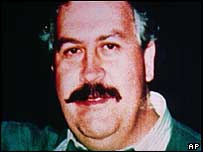
The magazine quoted from the 1991 report that Mr Uribe was a "close
personal friend" of the Medellin cartel kingpin Pablo Escobar,
killed in 1993.
But Bogota dismissed the allegations as an attempt to smear the
president.
'Dedicated to collaboration'
The Newsweek article says the defence department intelligence
document - dated September 1991 - contains a list of more than 100
"thugs, assassins, traffickers and shady lawyers" employed by
Escobar.
At number 82, the document reportedly says, is: "Alvaro Uribe Velez
- a Colombian politician and senator dedicated to collaboration with
the Medellin cartel at high government levels.
"Uribe was linked to a business involved in narcotics activities in
the US... Uribe has worked for the Medellin cartel and is a close
personal friend of Pablo Escobar Gaviria."
The document also reportedly claims Mr Uribe's father was killed
because of his son's links to drugs traffickers and that Mr Uribe
opposed a US-Colombia extradition treaty.
In a statement, Mr Uribe's office insisted his father was killed by
leftist Farc guerrillas for resisting kidnap. It points out that Mr
Uribe has authorised a record 170 extraditions to various countries
as president.
But the statement did not specifically rebut allegations that Mr
Uribe was a close friend of Escobar or had links to the Medellin
cartel.
Mr Uribe, who celebrates two years in the presidency this week, is
now viewed as a close US ally.
In Washington, a spokesman for the state department said it
"completely disavowed" the allegations.
"President Uribe's record is one of a strong opponent of drug
trafficking," said Robert Zimmerman, deputy spokesman on Western
Hemisphere affairs.
The Colombian government was criticised last week for granting three
warlords from the country's most notorious paramilitary group, the
AUC, immunity from arrest to address Congress.
The president's policy to crush leftist rebels - which includes mass
round-ups of suspected rebel collaborators and lenient sentences for
paramilitaries who renounce trafficking and violence - has been
criticised by human rights groups.
Despite that, after four decades of devastating civil war, many
Colombians are pleased with Mr Uribe's hardline stance against the
guerrillas.
Mr Uribe's office pointed out that similar allegations were made
against Mr Uribe in the run-up to his election in 2002.
Colombians elected him in a landslide victory despite those
allegations.
At least 256 confirmed dead in Paraguayan supermarket fire
At least 256 people were killed and hundreds of others
injured Sunday in a fire that swept through a supermarket on the
outskirts of Paraguay's capital Asuncion, the Paraguayan government
confirmed Monday.
The government said the death toll was expected to rise, according
to reports reaching here from Asuncion, capital of Paraguay.
The fire broke out at a time when the supermarket was crowded with
Sunday midday shoppers. The reports said nearly 1,000 people had
been inside the shopping center, which is part of the complex that
also houses offices and an underground parking lot.
Police said firefighters and police are recovering bodies and
rescuing the injured from the complex.
Police said two explosions were heard moments before the fire broke
out. The blasts were likely to be caused by gas leak of the gas
canisters in the supermarket and subsequently ignited the
devastating blaze that consumed a significant part of the
supermarket within the shopping complex.
Officials said there are concerns that the 30-meter-high complex
might collapse.
The shopping center belongs to the Ycua Bolanos chain and includes
several fast-food outlets in addition to the store.
Witnesses said that doors within the complex had been deliberately
closed so that people could not leave without paying, and that this
had hampered people seeking to escape.
The owner of the complex has surrendered himself to the police in
the wake of the blaze, but denied categorically that there had been
an order to close the complex's doors.
Hundreds of fire fighters, emergency workers, doctors, military
servicemen and volunteers rushed to the site and fought the fire.
The blame was controlled three hours later and was extinguished at
about 6:00 p.m. local time.
The rescuers were still recovering bodies from the debris, and
nearly 130 bodies have been identified but many others cannot be
identified because of being badly burned. Local media said the
deaths would reach 300 as more corpses were being retrieved.
Paraguayan President Nicanor Duarte has visited the scene and vowed
to minimize the impact of the disaster.
Argentina and Spain have offered Paraguay emergent medical aid.
Pinochet's son released from detention, banned from leaving Chile
The son of former Chilean dictator Augusto Pinochet was released
Saturday after two days in detention, but he was banned from leaving
the country when the authorities were continuing to investigate
whether he was involved in an illegal sale of vehicles.
Prosecutor Vinko Fodic said Augusto Pinochet Hiriart was released
after he was formally accused of forging license plates, illegally
receiving vehicles and bearing arms in an illegal way.
Appearing in court Saturday, Pinochet Hiriart said he is "convinced
that I will be able to prove that I am innocent. I am a man of
honor."
He was detained Thursday at the Infirmary of the Penitentiary of
Curico, 180 km south of Santiago, where he will have to check in
every 15 days at the local court.
Pinochet Hiriart and two others were accused of using forged license
plates and receiving a stolen car. But none of them has been
indicted.
Pinochet Hiriart was also accused by Fodic of illegal possession of
a gun, after a revolver was found at his residence. The Colt
32-caliber revolver was registered in the name of his father, and it
was illegal to keep a gun in the home of someone other than the
official owner.
The legal problem for Pinochet Hiriart came after his father was
being investigated for his 8 million US dollars in secret accounts
at Riggs Bank in the United States.
Pinochet, 88, was implicated in a drawn-out legal battle over
charges of human rights abuses during his 17-year rule from 1973 to
1990.
The trial for Pinochet was cut short in 2001 when he was diagnosed
as mentally incompetent.
|