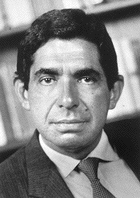
Arias Early Frontrunner
Former president Óscar Arias
Sánchez is the top presidential
hopeful in Costa Rica, according
to two separate polls conducted
by by Unimer published in the
Spanish daily La Nación
and CID Gallup.
41 per cent of respondents in the Unimer poll would vote for Arias
in the next election, while 52% respondent in favour in the CID
Galllup poll.
In March, the 63-year-old Arias officially announced his intention
to run for president again. He is likely to face Antonio Álvarez
Desanti in an internal National Liberation Party (PLN) primary.
The Costa Rican congress opted to bring back presidential
re-election last year. A president can now be re-elected for one
additional term, but not consecutive.
Arias headed the government from 1986 to 1990, and is still regarded
for his democratic proposals and actions on how to deal with
violence in Central America.
The poll shows that Ottón Solís of the Citizens Action Party (PAC)
is second with 14 per cent, followed by Otto Guevara of the
Libertarian Movement (ML) with nine per cent.
Solís's presidential bid in the last election forced the a run-off
election for the first time in Costa Rica history.
Unimer / La
Nación Polling Data
Which of these prospective
presidential candidates
would you vote for in the
next election?
Oscar Arias (PLN): 41%
Ottón Solís (PAC): 14%
Otto Guevara (ML):
9%
Methodology: Interviewed
1,355 Costa Rican adults,
conducted from Jun. 28 to
Jul. 9, 2004. Margin of
error is 2.7 per cent. |
CID-Gallup
Polling Data
Do
you have a favourable or
unfavourable opinion of the
following politicians?
Óscar Arias Sánchez: + 52%
Rogelio Ramos: + 38%
Johnny Araya: + 32%
Abel Pacheco: + 18%
Methodology: Interviewed
1,297 Costa Rican adults,
conducted from Jul. 10 to
Jul. 19, 2004. Margin of
error is 2.8 per cent. |
The next presidential election in Costa Rica is tentatively
scheduled for February 2006.
Central Bank Tightens Monetary Policy To Stave Off
Inflation
by Mike Godfrey, Tax-News.com
As the country faces increasing inflationary pressures, Costa Rica’s
Central Bank President has announced a tightening of monetary policy
in an attempt to ensure future economic stability.
“If we have to choose between stability and growth, we choose
stability,” stated Central Bank President Francisco de Paula
Gutiérrez on Monday, according to the Tico Times. Economic forecasts
foresee inflation reaching 11% this year – the highest rate in six
years.
“In general, the price of money will go up. These policies will make
credit more expensive. It will also make imported goods more
expensive. It will make people consume less and save more,”
Gutiérrez explained.
Likening the measures to piloting an aircraft through storm clouds,
the central banker explained: “We’re telling people to fasten their
seatbelts.”
The inflationary pressures on the economy have been blamed to a
large extent on the rising price of crude oil, which has once again
broken above the $40 per barrel mark.
Central Bank policy makers previously based their plans on the
assumption that the price of oil would pivot around the $28 per
barrel mark.
However, economic data shows that the prices of both consumer goods
and raw materials have also been rising since the end of last year,
contributing to the inflationary effect.
Nevertheless, Gutiérrez has indicated that he is prepared to be
flexible over future monetary policy if there are any major changes
to Costa Rica’s economic circumstances, or if the nation’s
long-awaited tax reform plan is approved by the legislature.
Catholic Church Offers Public
Apology for Sexual Abuses by
Priests
The Catholic Church
in Costa Rica yesterday asked
publicly for forgiveness for the
sexual abuse of minors
perpetrated by some priests.
The apology was offered by the
monseñor José Francisco Ulloa
Rojas, bishop of Limón and
president of the Conferencia
Episcopal de Costa Rica, which
united the 10 bishops in the
country, in a commemoration
ceremony on the day of the
patron saint of Costa Rica, la
Virgen de los Ángeles.
The monseñor addressing the
devoted attending the mass at
the Basilica de Cartago, with
humility asked those in
attendance for forgiveness for
all the harm and pain caused by
the actions of some priests. He
promised to continue to apply
stringent measures to avoid any
further situations.
The declaration was made at the
9:30 mass following the
pilgrimage of an estimated
million people who walked to
Cartago over the weekend.
The monseñor remarked, that of
the 800 priests in Costa Rica,
one can count on one single hand
the number of priests who have
been delinquent, recognizing
that the pain and suffering
caused by those few is not
easily erased.
In the past year, the courts
have handed down firm sentences
against two priests for sexual
abuse in Cartago and San Carlos;
one was sentenced to 12 years,
while the other to fours years
in prison. This does not include
the charge a against the priest
in San Carlos who is still at
large, avoiding capture by
police.
Monseñor Hugo Barrantes,
archbishop of San José, said
that the forgiveness offered is
line with the teachings of Pope
John Paul II.
President Abel Pacheco, who
along with is wife, attended the
morning mass, commented that it
pains him much that church has
to offer forgiveness for the
actions of a few.
The church also yesterday asked
for the prohibition of the
contraceptive "the day after
pill" and the for the approval
of the "sex education" guide
prepared by the church to be
used in the country's schools.
Chilean Ambassador to be
Replaced
The Chilean
Ambassador to Costa Rica,
Guillermo Yunge, will leave his
post in September.
Yunge is expected to give his
report to the Chilean capital on
the tragedy of last Tuesday,
when a member of the Fuerza
Publica guarding the embassy,
killed three diplomats before
killing himself.
Yunge is not a career
politician. He was appointed
Ambassador in 2000 and his
removal is rumoured to be due to
pressure placed on the Chilean
government of the families of
those killed.
|