


Latin America is the deadliest region for human rights, environmental activists, group says
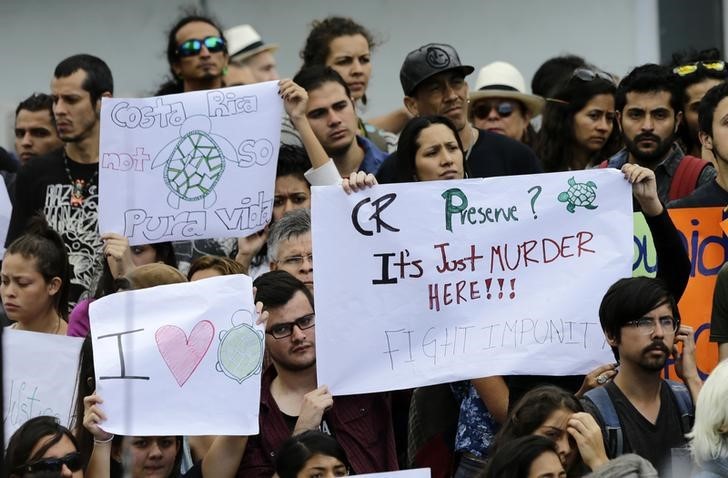
January 29, 2015: Environmentalists protest after a Costa Rican court acquitted seven men accused in the brutal murder of environmentalist Jairo Mora and the rape of four volunteers who worked with him to protect sea turtles, in the coastal city of Limon. REUTERS/Randall Campos
By Anastasia Moloney
BOGOTA, January 7th, 2015 (Thomson Reuters Foundation) – Latin America is the deadliest region for human rights activists with scores killed defending land rights, the environment and the rights of LGBTI and indigenous people, a campaign group said on Wednesday.
In the first 11 months of 2015, 156 human rights defenders globally were killed or died in detention, up nearly 15 percent from the previous year, with more than half of the killings taking place in Latin America, and Colombia alone accounted for 54 murders, according to a report by Front Line Defenders.
“Defending human rights in Latin America remained extremely dangerous and the criminalisation of the defence of human rights and peaceful protest movements persisted. The most worrying issue remained extreme violence,” the report by the Dublin-based campaign group said.
Outside of the Americas, the Philippines fared worst with 31 killings of human rights activists, the report said.
The persecution and harassment of human rights campaigners globally included death threats, arbitrary detention, physical attacks, police brutality and the homes and offices of activists being broken into, the report said.
“Human rights defenders face increasingly restrictive and brutal environments in every region of the globe,” said Mary Lawlor, head of Front Line Defenders, at the launch of the group’s annual report in Dublin.
“Extreme violence is being used more frequently and in more countries, while fabricated prosecutions and unfair trials have become the norm in many parts of the world,” she said.
Alongside state agents, companies and paramilitary groups were behind many cases of attacks and intimidation against human rights activists, according to the report.
The report found that in Latin America, most at risk were activists defending land rights from big mining projects and logging, often on land belonging to indigenous groups, especially in parts of Central America, Colombia, Mexico, Peru and Ecuador.
In Brazil, the report said human rights activists and indigenous leaders from the Ka’apor and the Guarani-Kaiowas communities have been targeted by logging companies operating illegally in the Amazon rainforest and by local farmers who claim rights over lands recognised as indigenous ancestral land.
The report found campaigners defending the rights of lesbian, gay, bisexual, transgender and intersex (LGBTI) people, accounted for 15 percent of the 87 killings of rights activists reported in Latin America, particularly in Honduras, making them the second-most targeted group of activists in the region after land and environmental campaigners.
The report said impunity for attacks against human rights campaigners globally remained “rampant” and authorities showed “no interest or willingness to pursue justice”.

ATTENTION: If you are seeing this message,
- Ken Morris
- Chris Thomas

