


Number of non-violent drug offenders in Costa Rica, LatAm prisons up sharply: research group
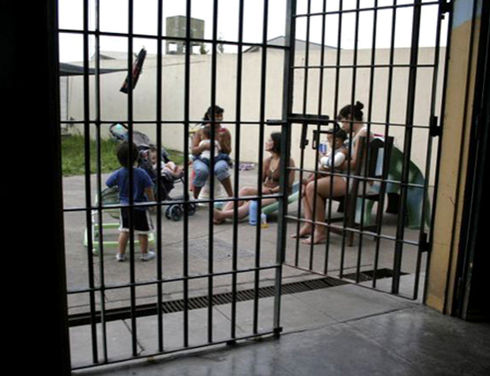
Women with children are amongst those serving time behind bars. (Photo courtesy of Costa Rica’s Judicial Investigation Organization)
MEXICO CITY, November 4th, 2015 (EFE) Latin American countries including Costa Rica have seen a sharp rise in the incarceration rate for non-violent drug offenders, a segment whose growth has been faster than that of the general prison population, a series of new studies by the Research Consortium on Drugs and the Law, or CEDD, shows.
“In the majority of the Latin American countries surveyed, one out of every five persons in prison is incarcerated for drug offenses,” Alejandro Corda, a CEDD researcher from Argentina, was quoted as saying in a press release.
“Moreover, the population incarcerated for drug-related offenses in several of these countries has increased at higher rates than the general prison population,” he added.
The research was unveiled Tuesday in Mexico’s lower house of Congress during a forum titled “People Deprived of Liberty for Drugs in Latin America: The Social Costs of Drug Policy.”
The studies encompassed nine countries in the region: Ecuador, Bolivia, Peru, Costa Rica, Brazil, Colombia, Uruguay, Argentina and Mexico.
The number of inmates behind bars for small-scale drug dealing or drug transporting ranges from 10 percent of the overall prison population in Mexico to 27 percent in Bolivia.
All of the countries saw an increase in the number of people incarcerated for non-violent drug offenses. In Brazil, the number was up 320 percent between 2005 and 2012, compared to a 51 percent increase in the general prison population.
Brazil is the country with the largest share of incarcerated non-violent drug offenders, who make up 25 percent of the total prison population of 548,000 inmates.
In Colombia, whose incarceration rate in 2014 was 245 people per 100,000 inhabitants, the number of people imprisoned for drug-related offenses rose 369 percent between 2000 and 2014, while the rise in the general prison population was 136 percent.
In Mexico, one of the countries most affected by drug trafficking in recent years, the number of people incarcerated in federal prisons for drug crimes rose 1,200 percent between December 2006 and December 2014.
Roughly 60 percent of people incarcerated in nine Mexican states are imprisoned for marijuana-related offenses, according to the CEDD, which includes members from Argentina, Brazil, Bolivia, Colombia, Ecuador, United States, Mexico, the Netherlands and Peru.
“But this incarceration has no impact on the drug trade because people in prison for drug offenses tend to be low-level traffickers, easily replaced, and persons in vulnerable situations,” Corda said.
The studies also highlighted “a worrying increase in the number of women incarcerated for drug offenses,” the vast majority of whom “are single mothers, young and low-income people, and often belong to ethnic minorities.”
EFE with minor editing from ICR News.

ATTENTION: If you are seeing this message,
- prdatki

